At Jackson Hole in August, US Federal Reserve Chair Kevin Warsh described AI as “a new variable, potentially a new factor of production”. Investors must question the extent to which this new factor will deliver sustained productivity gains, how it will interact with labour, and where any surpluses might accrue.
AI and geoeconomic fragmentation
The debate around frontier models shows that AI is becoming a matter of national sovereignty and security as much as economic growth. Some industry leaders favour greater caution, while governments are reluctant to restrain a technology viewed as central to competitiveness and national security. This tension is especially visible between the US and China, where access to advanced chips and frontier models is part of the strategic contest and China’s progress in open-weight models has intensified questions about whether restrictions can preserve technological leadership.
For investors, these questions can be reduced to two:
- Will AI make the economic pie bigger and how quickly?
- If it does, who gets not only the bigger slice but also the absolute level of share?
The two are connected because the distribution of AI gains, both within and between countries, will influence consumption, investment, social acceptance and political responses, helping to determine how widely the technology diffuses.
Will AI make the pie bigger, and how fast?
In our July paper, AI and the global economy: A framework for investors, we argued that AI’s macroeconomic impact depends on whether today’s build-out translates into higher productive capacity and economy-wide productivity, and how labour responds.
At the simplest level, GDP growth reflects growth in labour productivity multiplied by growth in total hours worked. AI may allow workers to produce more per hour, but if it simultaneously reduces employment or hours, part of the productivity dividend is offset.
Productivity growth and GDP growth therefore do not necessarily go hand in hand.
Our analysis formalises these dynamics through an augmented Solow model in which AI enters the economy through two channels. The first is AI as capital: investment in compute, models and data infrastructure raises output through capital deepening, but mainly generates a transitional boost to growth. The second is AI as technology: as AI diffuses through firms, it can improve workflows, accelerate innovation and raise total factor productivity, creating a more persistent increase in growth.
Current evidence looks clearer for the first channel. Since 2022, US labour productivity has risen at a 2.5% annualised rate, compared with 1.4% for total factor productivity, which is consistent with capital deepening rather than clear evidence of a new productivity regime. Our bottom-up equity research also suggests AI infrastructure demand has yet to roll over, although investor scrutiny is shifting from capital spending towards monetisation, productivity, cash flow and returns.
Labour is the other side of the equation and our production framework, reported in appendix, models this explicitly. If AI mainly augments workers, an adviser can serve more clients, or an engineer can write more code without an equivalent reduction in labour demand. If AI is highly substitutable, firms can use more AI capital while requiring less labour to perform the same activities, meaning higher productivity may translate less fully into GDP due to hit to labour income and consequently, consumption.
The evidence so far suggests a mixture of augmentation and selective substitution. In our 2026 Analyst Survey, seven in ten analysts said companies they cover were primarily doing more with the same headcount but some also reducing workforce sizes because of AI. A separate 2026 academic study that surveyed executives around the world found that businesses expected AI to raise productivity by 1.4% over three years and reduce employment by 0.7%.
This helps explain why we expect AI’s impact on economic growth to be positive, meaning that the economic pie gets bigger, but gradual rather than explosive. Computing capacity can be installed quickly, while reorganising businesses, retraining workers and deciding which processes can safely be delegated take much longer. The size and speed of this growth dividend have already been incorporated into our Capital Market Assumptions, published in April, where a larger AI-driven economic pie translates into stronger long-term equity revenue growth.
Who gets the bigger slice?
Even if AI makes the pie larger, that does not tell us who captures the additional income. Productivity gains can flow to workers through higher wages, consumers through lower prices, companies through higher profits, or governments through taxation.
A key variable to watch is therefore labour’s share of income and our model links its future direction to the balance between augmentation and substitution.
History offers useful parallels. During the late-1990s technology boom, US labour share increased from around 61% in 1997 to roughly 63% by 2000 as information technology contributed to the productivity acceleration. This experience underpins our High-AI scenario, where AI predominantly augments workers, new tasks emerge sufficiently quickly, and labour share rises by around 1.5% over ten years.
The period after the dot-com boom provides a different guide. US non-farm business labour share fell from 62.8% in 2000 to 56% in 2011, although technology was only one of several forces behind that decline. Our base case envisages a milder version of this dynamic, with AI supporting growth while substituting for a meaningful share of existing tasks and labour share falling by around 2.5% over ten years.
Figure 1: The US labour share decline
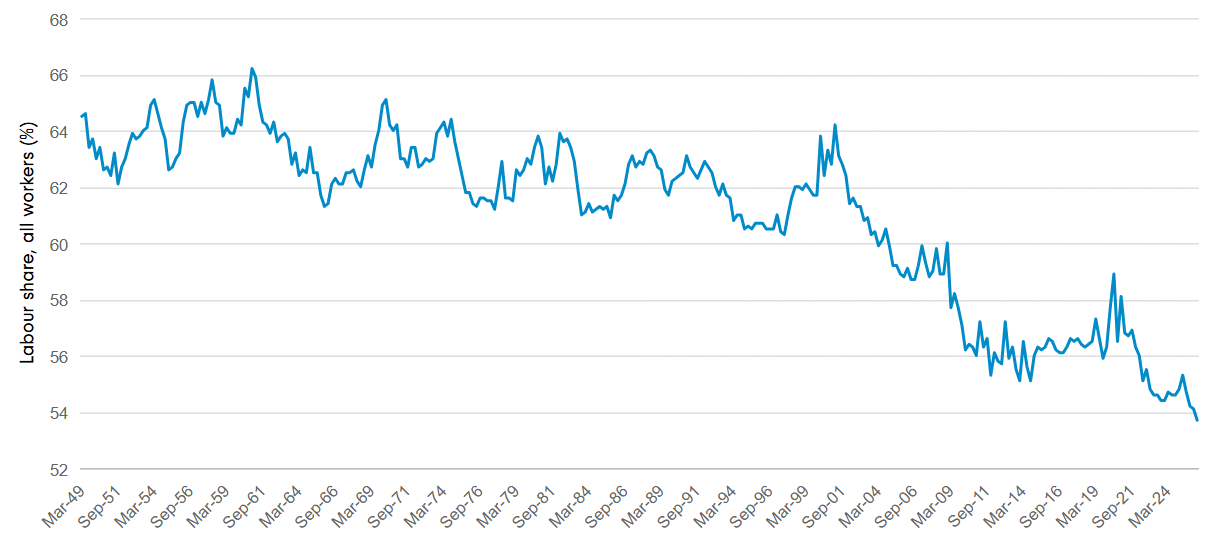
Source: Bureau of Labor Statistics, Fidelity International, 30 June 2026.
The Low-AI scenario represents a more disruptive outcome in which AI becomes effective at automating existing tasks while new-task creation and labour reallocation remain weak. In this scenario, we assume labour share could fall by around 5%, with labour-market disruption offsetting much of the productivity benefit and leaving little additional trend-growth dividend.
This case would create the greatest political strain because AI could replace tasks without generating enough new income and growth to compensate society for the disruption. Pressure for redistribution, worker protection, taxation or tighter regulation could strengthen and slow investment and diffusion. Early signs are visible in the US, where data-centre expansion has triggered local opposition and congressional scrutiny over electricity, water and infrastructure pressures.
Distribution also operates between countries. AI has increasingly moved from corporate strategy into industrial policy and national security, even though its production chain remains deeply international, linking US chip design and cloud platforms with European semiconductor equipment, Taiwanese fabrication, Korean memory and Chinese mineral processing. As governments seek greater control over strategic inputs, the AI growth dividend will increasingly depend on geopolitics as well as technology.
The next stage of our work will examine how a larger economic pie translates into corporate profits, focusing on labour costs, taxation and interest expense as firms finance the capital required to build and deploy AI.
Read our full white paper
AI and the global economy: A framework for investors
"We expect AI’s impact on economic growth to be positive, but that does not tell us who captures the additional income."
Technical appendix: An augmented Solow model of AI
Our framework extends the augmented Solow growth model so that AI enters the economy in two distinct roles: as an accumulable factor of production and as a technology that can raise the underlying rate of productivity growth. This distinction separates the immediate effects of the AI investment boom from the potentially more persistent effects of diffusion.
Baseline. Output is produced from physical capital K, human capital H and efficiency-adjusted labour AL:
Y = Kα Hβ (AL)γ, where γ = 1 - α - β.
In the standard Solow framework, accumulating more capital raises the level of output but does not permanently increase its growth rate, which is ultimately determined by technological progress, g.
AI as capital. We introduce an AI capital stock M, encompassing compute, models and data infrastructure, and combine it with labour through a constant-elasticity-of-substitution structure:
N = [(1 - ω)(AL)ε + ωMε](1/ε), where ε = (σ - 1)/σ,
and Y = Kα Hβ Nγ.
The key parameter is σ, the elasticity of substitution between AI capital and labour. If σ < 1, AI and labour are complements; if σ > 1, they are substitutes. Greater AI investment raises productive capacity and creates a transitional growth boost, but does not by itself raise the long-run growth rate.
Labour share. The same structure determines how AI affects distribution. Labour's income share is ℓ = γ[1 - π(M)], and:
∂ ln(ℓ) / ∂ ln(M) = -επ(M).
The sign therefore depends on σ: AI deepening raises labour share when σ < 1 and lowers it when σ > 1. The model identifies the direction and mechanism of this effect. The labour-share magnitudes used in the blog scenarios are informed by historical experience rather than mechanically taken from the illustrative model calibration.
AI as technology. We also allow AI diffusion to raise labour-augmenting technological progress:
g(t) = g0 + φχ(t),
where χ(t) is a diffusion curve and φ is AI's eventual contribution to trend productivity growth. Unlike capital deepening, this channel can produce a persistent increase in trend growth, although it arrives more slowly as firms reorganise workflows, retrain workers and integrate AI into production.
Combined effect. The growth impact can be summarised as:
gY(t) = g0 + A(t) + B(t) - d(t),
where A is the fading capital-deepening contribution, B is the rising technology contribution and d captures labour displacement when substitution runs ahead of new-task creation. The model therefore frames AI's macroeconomic effect as a race between capital accumulation, productivity diffusion and labour adjustment. It also explains why capex alone is a poor guide to the eventual outcome: total factor productivity, labour share and employment dynamics provide more informative signals of which scenario is emerging.