This article first appeared in Livewire on 10 March 2026
The story being sold to investors around BHP Group (ASX: BHP) is that copper companies demand higher valuations than iron ore companies, thereby justifying the recent rally and all-time high share price. But is that promise or puffery?
It’s a question worth asking because BHP is not just another stock. For most Australians, the Big Australian is a portfolio staple, steeped in history and national pride as one of our few companies that competes (and wins) on a truly global scale. Selling it, and even talking it down, can feel almost un-Australian.
Which is why its recent performance has been so closely watched. The world’s largest miner is up roughly 35% over the past 12 months and more than 16% year-to-date at the time of writing.
The rally has been fuelled by broadly strong commodity prices, as well as company specific performance: a healthy interim result that delivered an 11% jump in revenue, a 44% increase in the interim dividend, and a landmark shift in the business itself, with copper overtaking iron ore to account for more than 50% of group EBITDA for the first time in the company’s history.
For a company that occupies a place in most Australian portfolios, the question investors are increasingly asking is simple: has BHP run too hard?
Not necessarily, according to Zara Lyons, Portfolio Manager & Analyst at Fidelity International. She believes the move reflects a structural shift in the business rather than a short-term commodity upswing.
"The diversification of earnings can arguably support a higher multiple versus a pure iron ore play."
The bull case is building, but with the stock at record levels, expectations have also risen. In this wire, we explore whether BHP can keep growing, or whether it has gotten too big for its boots.
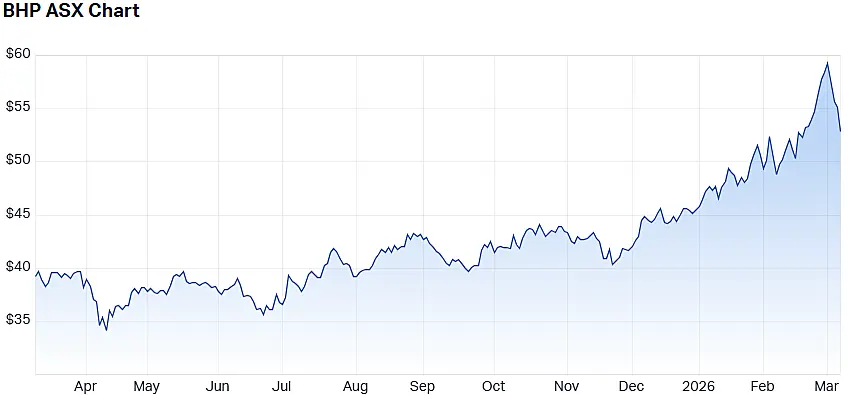
BHP 1-year performance. (Source: Market Index)
Is the rally sustainable?
Lyons says the recent rally reflects stronger earnings, improving capital returns and growing confidence in BHP’s long-term strategy.
"The stock has enjoyed a rally following its recent interim result, as earnings beat consensus, the payout ratio was increased to 60% (well above the >50% floor), and the company announced the sale of a silver stream for US$4.3bn, which will assist in funding future capex."
Copper was the standout contributor, with Lyons noting that “the copper division led the earnings beat, pushing copper margins above iron ore.”
The shift reflects a strategy years in the making. BHP CFO Vandita Pant recently told Livewire the company had deliberately pivoted toward “future-facing” commodities.
“This is the result of executing our strategy for the past three to four years. We had said that we wanted to grow in copper and that is what has been happening.”
Analysts broadly agreed the result reinforced the copper story. JPMorgan highlighted stronger performance at Escondida and lifted its price target to A$58 while maintaining an Overweight rating, pointing to BHP’s leverage to copper.
Still, Lyons cautions that sustainability will depend on a few key variables.
“In our view, the three key factors are copper prices and volumes remaining firm, China steel demand avoiding a sharp downside, and delivery on growth projects - notably Jansen - without cost blowouts. With the stock at record levels, there is less margin for error.”
The copper backdrop may help. JPMorgan expects a refined deficit of around 330,000 tonnes in 2026, and for BHP every US$100 per tonne move in copper shifts EBITDA by roughly US$220 million to US$260 million.
How investors should value BHP today
BHP’s shift toward copper is changing how investors think about valuation.
Lyons says Fidelity values the company using a combination of net present value (NPV) and EBITDA multiple analysis - normalising iron ore margins through the cycle, assigning higher multiples to copper cash flows to reflect scarcity and electrification demand, and discounting growth capex, including the Jansen potash project, for execution risk.
“The key point is that copper's share of group earnings has risen, reducing single-commodity risk and making earnings more genuinely diversified.”
Historically, BHP has largely been valued as an iron ore company. But with copper now accounting for a growing share of earnings, that framework may be shifting.
ClearBridge Investments Portfolio Manager Michael Slack believes the shift could drive a rerating.
“Copper becomes a larger part of their mix… and we know copper companies trade on higher multiples than iron ore companies.”
Alphinity’s Stuart Welch has also described BHP as a high-conviction resources exposure that “provides leverage to copper, iron ore and metallurgical coal,” backed by “quality management and strong balance sheet.”
Lyons argues the evolving commodity mix aligns BHP with long-term demand drivers such as electrification and AI data centres, potentially shifting how the market values the company.
Street consensus following the February results placed the average broker target around A$51.80, slightly below the current share price of A$52.81. That suggests much of the near-term upside may already be reflected in the price. In other words, further gains may depend less on multiple expansion and more on BHP delivering on its copper growth strategy.
The key drivers over the next six to 12 months
Looking ahead, Lyons believes several operational and market variables will determine BHP’s performance over the next year.
“In our view, the four key drivers are copper volumes and grades, iron ore realisations tied to China steel demand, capex and schedule confidence across the growth pipeline, and the capital returns profile.”
Copper production has been encouraging, with operations in Chile and Copper South Australia delivering record or near-record output.
Iron ore remains critical, underpinning BHP’s cash flow and dividend capacity.
Execution will also matter, particularly capex discipline and schedule confidence across the growth pipeline, including the Jansen potash project.
Capital returns remain another pillar of the investment case. The interim dividend of US$0.73 per share, representing a 60% payout ratio and a 44% increase on the prior year, signalled confidence in the company’s cash generation.
As CFO Pant said, “We know how important dividends are to our shareholders and over the last 10 years we have paid back more than US$110 billion in returns to our shareholders.”
The risks investors can't ignore
No bull case comes without risks. Lyons flags a sharper China slowdown as the primary macro threat, which could weigh on both iron ore and steelmaking coal demand. A pullback in copper prices driven by macro weakness is another.
Project execution is also critical. Slack highlighted the challenge of valuing long-dated growth assets, pointing to the Vicuña copper project in Argentina and Chile as an example.
“One of the difficulties in valuation is just the long-dated nature of BHP’s growth pipeline.”
The project is a massive resource but will be developed in phases, with final investment decisions expected later this year and further expansion opportunities stretching well beyond that.
Can BHP go higher from here?
Lyons’ upside case rests on continued copper strength, stable iron ore prices and disciplined execution of the company’s growth pipeline. Dividends also remain a key component of total returns, given BHP’s commitment to paying out at least 50% of earnings.
Slack struck a similarly bullish tone following the February results, noting his fund remained overweight the stock.
“We are overweight. We’re still buyers.”
BHP has also lifted its long-term production growth ambitions from 2–3% to 4–5% through to 2035, driven largely by copper expansion.
Pant believes the company’s diversified pipeline, spanning copper, potash and other future-facing commodities, supports that outlook.
“The sustainability of this performance is writ large across the performance of all our assets.”
BHP has already had a strong run. But if copper continues to reshape the business, the market may still be working out what the company is really worth.
So, can BHP go higher from here?
After speaking with Lyons and digging through broker notes and recent interviews, the message seems fairly consistent. In the short term, the stock may have already run too hard.
But step back, and the longer-term picture still looks bullish.