This article first appeared in i3 on 14 July 2026
Despite the current geopolitical volatility around the world, and the political upheaval that comes with it, the energy transition is well underway.
Global investments in the transition to renewable energy reached a record US$2.3 trillion in 2025, up 8 per cent from 2024, according to data from BloombergNEF, and we are only at the very start of this multi-decade shift.
But the money going into this transition is not spread across sectors equally.
Understandably, power generation receives the lion’s share of the capital, as much of the required carbon abatement can be addressed by changing the way power is produced and distributed.
But power consumption is an equally important part of the equation.
"There seems to be a colossal volume of capital going into [the energy transition], and when we look at it, roughly three-quarters of that capital is focused on power generation in its various forms.
Rather than competing for all that capital that is going into power generation, you can address parts of the market that are starved of capital." – Adrian Benedict
It is not just the total level of consumption, but also the nature of how it is consumed that can provide meaningful improvements. Yet, this area is underinvested, Adrian Benedict, Head of Real Estate Solutions at Fidelity International, says in an interview with [i3] Insights.
“There seems to be a colossal volume of capital going into [the energy transition], and when we look at it, roughly three-quarters of that capital is focused on power generation in its various forms,” he says.
“Something approaching US$1.5 – 2 trillion [of the US$2.3 trillion] is going into power generation, while only one quarter is addressing consumption. Of that one quarter, close to 80 per cent, goes into electric vehicles.”
Yet, real estate is one of the biggest consumers of fossil fuels and people have started to take notice. There is a high demand for more green and energy-efficient buildings across the real estate sector. Office buildings have perhaps received the most attention, but there is an equally high demand in the logistics sector.
So much so, that there is a structural undersupply of energy-efficient logistics centres, Benedict says. “Rather than competing for all that capital that is going into power generation, you can address parts of the market that are starved of capital,” he says.
Looking for core assets in key logistical areas in Europe
Benedict and his team look for high-quality buildings in areas that are positioned along key logistical routes in Western Europe. This includes areas such as the Golden Triangle in the United Kingdom, an area roughly bordered by Birmingham, Nottingham and Bedford, the Lille to Marseille corridor in France and the major port areas of Amsterdam and Rotterdam in the Netherlands.
Once identified, they aim to significantly reduce the energy consumption of these logistics centres through various refurbishments and improvements, such as the installation of solar panels, LED lighting and automated operations. On average, they look to spend no more than 20 per cent in capex as a percentage of the acquisition value, after which they are usually able to increase rents by 30 to 40 per cent, while the asset now attracts a premium exit price too.
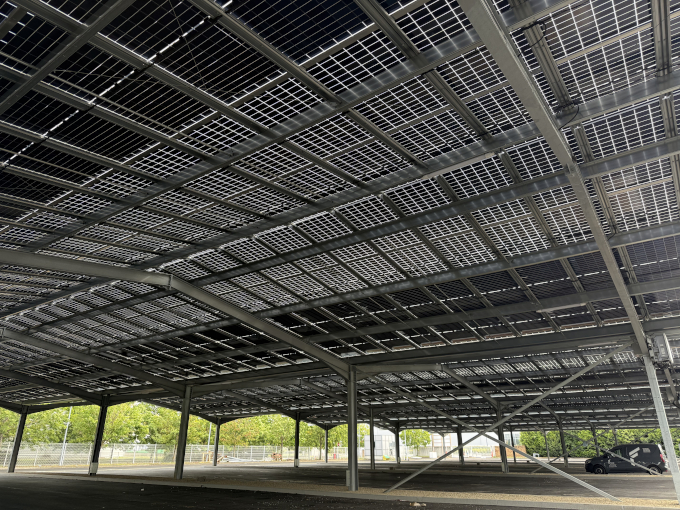
The Fidelity Combs-la-Ville warehouse is a 42,000-square-metre logistics facility located in the Sénart logistics hub in France. Fidelity reduced the energy consumption of the buildings by constructing a roof for the car park made out of solar panels. The panels can power all the lighting across the office, warehouse and outside areas, in addition to the AC system, two electric heat pumps for indoor heating and EV charging points. In peak PV production hours any surplus energy is reinjected back into the grid, providing potential income for occupiers. Photo: Maxine Kraut White
Delivering energy-efficient buildings in a market that has a structural undersupply doesn’t just create opportunities for good returns; it also means the risk of losing money is greatly reduced, Benedict says.
“One client said to us a while back: ‘It is value-add returns at core plus risk’, and in an environment where we know that uncertainty is rising, investors are really responding to that in a positive way,” he says.
Super fund Rest was one of the cornerstone investors in the strategy and cited the ability to deliver strong returns, while also supporting the transition to net zero as key benefits for institutional investors with long time horizons.
“We are seeing sustained growth in demand for high-quality logistics facilities that are energy efficient, especially in Europe. We believe the refurbishment of these well-located assets will unlock long-term value for our members,” Andrew Bambrook, Head of Investments, Real Assets at Rest, tells [i3] Insights.
“The majority of our members are decades from retirement, so our investment decisions are informed by the megatrends we believe are shaping the world they’ll retire into.
"We are seeing sustained growth in demand for high-quality logistics facilities that are energy efficient, especially in Europe. We believe the refurbishment of these well-located assets will unlock long-term value for our members."
“This LOGICs fund sits right at the intersection of two of these megatrends – decarbonisation and deglobalisation. We know that a significant proportion of global carbon emissions come from real estate, so energy efficiency is increasingly a priority and a valuable opportunity.”
Deglobalisation will also see more reshoring and friend-shorting of manufacturing and supply chains, which is likely to further increase the demand for European logistics centres.
“At the same time, we are seeing the ongoing onshoring of supply chains and expansion of e-commerce retail. We think these assets are well-placed to benefit from these megatrends and provide strong long-term returns for our members,” he says.
Reducing energy costs is key
Energy-efficient logistics centres attract a premium price, often up to 19 per cent over comparable buildings, but it is also the ability to raise rents where Benedict and his team make a significant part of their money.
Traditionally, this is done by reletting premises, essentially finding new occupiers who are willing to pay the higher prices. But Benedict has found that many of the existing tenants are willing to negotiate new leases, because they can see how much the refurbishments will save them in operating costs.
“It doesn’t matter whether you speak to a 50-year-old, or indeed a 15-year-old, if you ask them what a measure of efficiency is, then it is basically about: ‘How much do I have to pay for my energy?’
“And if my bill is quadrupled, I would say that doesn’t feel like a particularly energy-efficient building,” he says.
“What we’re able to do is demonstrate and prove to them the level of energy saving they’re going to be able to achieve,” Benedict says.
It doesn't matter whether you speak to a 50-year-old, or indeed a 15-year-old, if you ask them what a measure of efficiency is, then it is basically about: ‘How much do I have to pay for my energy?’ And if my bill is quadrupled, I would say that doesn't feel like a particularly energy-efficient building."
Tenants are sensitive to reductions in energy consumption, not just from a sustainability point of view, although that is important too, but also because energy costs have risen dramatically in Europe in recent years. A key turning point in this trend was the start of the war in Ukraine, which disrupted energy supply and sent prices structurally higher.
“In Europe, we’ve actually been in a pretty fortunate position that we’ve always had relatively accessible and cheap sources of energy. That has progressively changed, and then there was a very marked change following the Ukraine war, and that is what has really accelerated this [trend],” he says.
Although refurbishments can be quite disruptive, Benedict has found that in today’s market many occupiers are willing to cope with the inconvenience, because they can see the cost savings ahead. He has even found that some tenants become enthusiastic participants in the planning process.
For Fidelity, it is another way to reduce the risk of the investment.
“We’re finding that there is a willingness of existing occupiers to remain in the building while the works are being done and while we undertake that lease regear, such that once the works are done the new lease is already in place,” he says.
Transparent metrics lead to goodwill
Much of this goodwill comes from the clear and transparent metrics the team use to measure their improvements. Fidelity has developed a set of 21 climate impact metrics that includes not just energy-efficiency measures, but also a broader framework of impact outcomes.
“We decided for this fund to be impact, because we wanted to make sure that nobody could accuse us of greenwashing,” he says.
“But I’m at pains to say that, fundamentally, the approach that we’re taking is to actually optimise financial performance. If we’re able to deliver logistics assets to the market that are much more energy efficient than competing spaces, then that means they’re more willing to take our space and pay more of a premium to use that space,” he says.
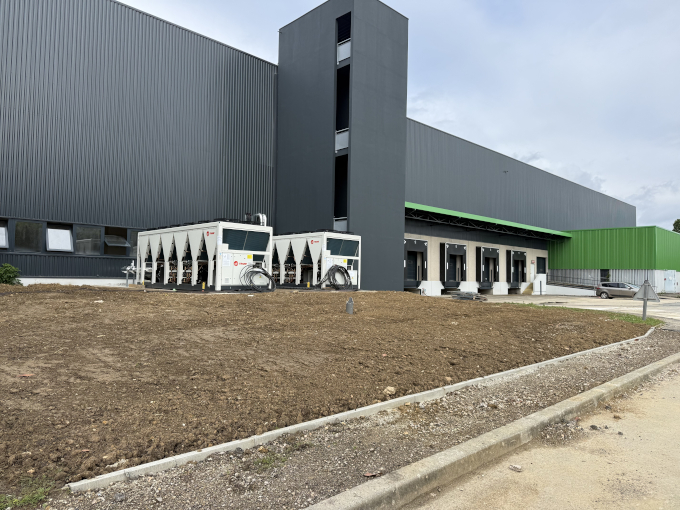
Heat pumps at the Combs-la-Ville warehouse. Photo: Maxine Kraut White
The transparency of metrics also allows occupiers to do their own calculations as to how much it will reduce their energy costs, which is a key factor in gaining their support.
“We can quantify the evidence, and they can then take that information, use their own consultants, to work out whether these are reasonable working assumptions or not,” he says.
“[Often they ask:] How can we accelerate this? How can we reconfigure this and make it even better? It becomes much more of a mutually agreed negotiation rather than an adversarial one,” he says.
Adding value over core prices
A good example of Fidelity’s approach is the recent acquisition of a logistics centre in Tilburg, the Netherlands, in 2025. This is a high-quality asset, located in a prime Dutch logistics hub. It had almost no vacancy and there was no new supply scheduled for the area.
Many real estate investors expected this asset to attract a premium price with little room for profits upon exit. But Fidelity projected that by repositioning the building, they could increase rents by 35 per cent and expect a value uplift of 45 per cent.
“A lot of competitors were saying: ‘How is Fidelity going to generate value and returns when it’s paying core pricing?’ But within a few months of buying the asset, we managed to secure a significant lengthening of the lease on one of the units, and secure a lease [price] of 24 per cent above the market [rate],” he says.
Dutch assets make up about 10 to 15 per cent of the fund, but Benedict sees plenty of opportunities there due to the access the country provides to the European hinterland.
Competition from data centre operators
E-commerce has driven much of the growth in the logistics sector in recent years as online shopping caused high demand for new and better-located distribution centres. For a while, it was the hot ticket in town.
But today strong economic growth is coming from artificial intelligence and developers of logistics centres increasingly face competition from data centre operators. These operators are encroaching on their territory by bidding on existing logistics centres in an effort to secure good locations and access to power.
“The demand for data centres is going through the roof in Europe, where land is scarce and power is even more scarce. What we’re finding is that data centre operators are actually buying logistics buildings, knocking them down, putting data centres in, because they’re already connected to the grid,” he says.
“They have to pay that little bit extra for the land or for the buildings and as a result logistics developers are increasingly being outbid by data centre developers. This is very much a phenomenon that we have started to see playing out in Europe in the last six to 18 months.”
But Benedict says Fidelity’s strategy is hardly affected by this new competition for assets, since they target smaller, core buildings which tend not to be on the radar of data centre developers.
“We’re buying more of those core locations, so they’re pretty central locations, and, by definition, you tend not to have the data centres piling in there,” he says.
“The assets that we go for are generally less than 100,000 square metres, and it tends to be slightly higher where you see the data centre operators wanting to bid for space,” he says.