Fidelity International’s technology analysts organised its 4th Annual Applied AI Day in May. The workshop highlighted how AI continues to move from experimentation toward real-world implementation. Discussions with private-market participants across the UK, China and the US focused on how improving model capability, falling inference costs and the rise of agentic systems are accelerating enterprise adoption.
Key themes included the growing importance of inference speed, visible productivity gains across workflows, and the larger opportunity to redesign business processes rather than simply automate them. The interactions with companies also highlighted evolving competitive dynamics between AI-native challengers and incumbents.
Overall, the discussion reinforced that the next phase of AI adoption will increasingly be defined by execution, workflow integration and commercial deployment.
A more applied conversation
Fidelity International’s Applied AI Day has become an annual forum for analysts, investors and industry experts to assess how artificial intelligence is being used in the real world, and how it is beginning to affect sectors beyond technology.
The discussion has evolved meaningfully over the past four years. In the early workshops, the focus was necessarily foundational: understanding generative AI’s capabilities and limitations, engaging with academics, product leaders and technology specialists, and building a framework for where AI could be useful, where it could be risky, and which industries might be most exposed. The 2023 workshop focused on understanding transformer models, hallucination risk and where AI could realistically be applied. By 2024 and 2025, the discussion had shifted toward enterprise adoption, against a backdrop of rapid improvement in model capability and falling inference costs. The focus broadened toward inference economics, proprietary data, autonomous systems and workflow integration, with increasing emphasis on rethinking IT architecture, data layers and business processes.
The 2026 workshop marked a further step forward. The discussion centred on private companies focused on disrupting existing industries, with participants spanning multiple geographies, including the UK, China and the US, and sectors ranging from enterprise software and legal services to autonomous systems and creative industries. Engagement with private-market participants gives Fidelity a differentiated perspective on evolving technologies, their funding environment, degrees of commercial traction and where value creation is emerging across the AI stack.
The key message from this year’s Applied AI Day was that AI continues to move from experimentation toward implementation. A major inflection point came with the release of Claude Opus 4.5 last November, which materially improved the ability of models to perform long-horizon coding and agentic tasks. The debate is no longer only about model capability. It is increasingly about deployment, integration, inference cost, workflow redesign and the competitive response from incumbents.
1. Model progress continues to improve; focus shifts from training to inference
The first takeaway from the 2026 workshop was that model progress continues to improve, with participants pointing to further acceleration in capability. Availability of training data does not yet appear to be hitting a wall, supported by increased use of synthetic data and world models.
At the same time, the rise of agentic systems is significantly increasing token demand, as models perform multiple tasks in parallel. One recurring theme from the discussions was that fast token generation matters as much as low-cost tokens. Several participants noted that developers are often waiting for AI systems to return answers, meaning faster responses can directly improve productivity and the overall speed of software development and enterprise workflows. This increasingly gives faster inference systems a competitive advantage, with some customers already willing to pay more for faster-performing models.
Performance of top models on the Arena* by select providers
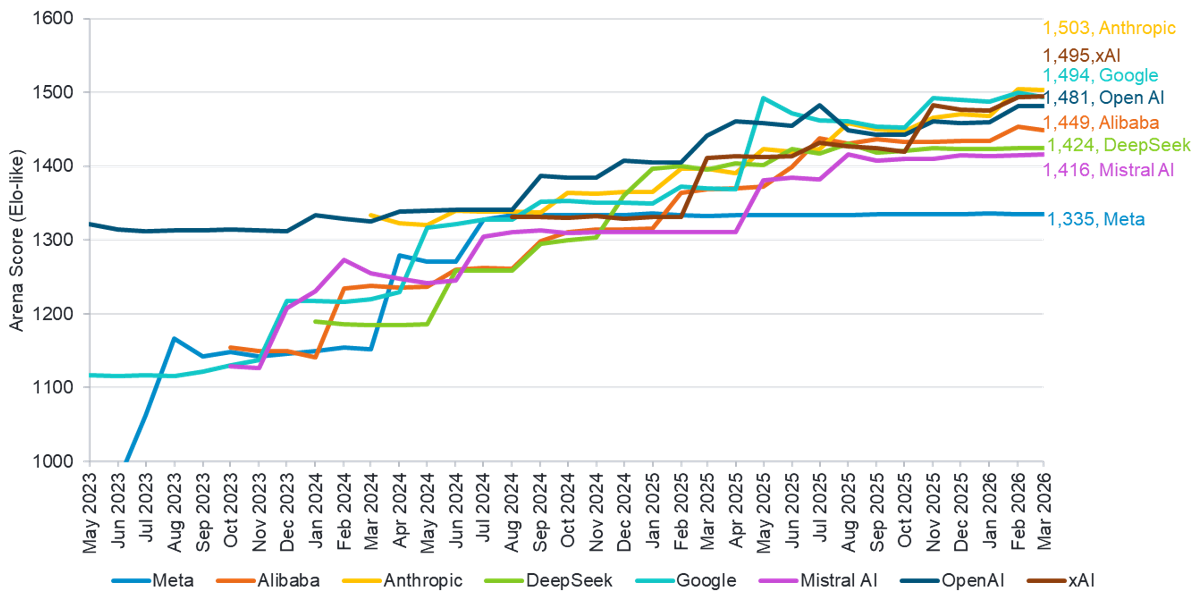
Source: AI Index Report 2026, Arena, 2026. *The Arena Leaderboard evaluates and ranks items (like AI models) using blind, head-to-head matchup voting.
2. Real-world cost savings are becoming more visible
The second takeaway was that AI is now delivering tangible productivity benefits in real-world workflows. The clearest examples remain areas where AI helps users complete existing tasks faster or more efficiently. These include coding, legal document review, market research, campaign design, customer analysis and internal knowledge work.
In legal services, for example, one AI-native platform demonstrated how automation tools can help professionals process more cases and review documentation more efficiently, while still requiring human oversight for higher-risk outputs. In creative industries, another participant highlighted how AI tools are compressing workflows that previously took months into weeks, while also reducing the number of people required to deliver client websites and digital assets.
The initial enterprise use case is often not radical reinvention but improving productivity and speeding up existing workflows.
Adoption, however, still depends on clean data, workflow integration and effective oversight, particularly in regulated or high-stakes industries.
3. The larger prize is in redesigning workflows
The third takeaway was that productivity gains from existing workflows may only be the first stage. The larger opportunity comes when AI enables companies to rethink how work is done.
This distinction is important. Using AI to make an existing process faster can produce real savings, but it may also become commoditised as competitors adopt similar tools. If everyone can use AI to reduce the cost of the same workflow, the benefit may ultimately be competed away. The more durable opportunity lies in redesigning the process itself.
The 2026 discussions offered several examples of this shift. In autonomous driving, one participant highlighted on pursuing a more generalised, bottom-up approach to the driving stack rather than relying on heavily hard-coded rules. In creative industries, AI is beginning to change the production process itself. One example discussed was how a fashion campaign photo shoot that previously required a full day of shooting and weeks of post-production could now generate multiple campaign images and videos from just one or two source images.
This is where the economics become more interesting. The question is not simply whether AI can reduce the cost of a task. It is whether AI can change the product, the workflow, the margin structure or the customer proposition. In some cases, AI may allow companies to move from one-off project revenue toward more recurring, software-like models. One example discussed was a branded digital tool built using AI coding assistants. The workflow itself was not necessarily faster, but the output changed, shifting the client conversation from a one-off creative project toward an ongoing software-style engagement.
4. Enterprise AI may favour both challengers and incumbents
The final takeaway was that competitive pressure is intensifying. AI-first businesses are not constrained by legacy systems or historical workflows, allowing them to operate with higher productivity with AI-native startups, often with smaller teams and faster product cycles.
At the same time, incumbents still retain important advantages in many enterprise markets, including customer relationships, embedded workflows, proprietary data and distribution. One takeaway from the discussions was that the market may split between vertical functions and more generalist enterprise workflows. In vertical functions, more focused AI-native category-killers, for example in legal or research software, may have an advantage. In more generalist workflows such as customer relationship management, incumbents remain well positioned because they already control the data and workflow layer. Some incumbents are also seeking to strengthen their position by putting up walls around data access.
The challenge for incumbents is speed. They need to adopt AI tools internally, ship AI-enabled products externally and continue innovating as competitive pressure rises.
For investors, this reinforces the importance of bottom-up research. The key questions are which companies have differentiated data, strong workflow integration and business models that can capture the value created by AI.