The US Federal Reserve (Fed) left rates unchanged at 3.50–3.75 per cent in line with the market consensus and going against the roughly one-in-three chance of a surprise hike priced into the meeting.
Key points
- With the Fed providing little guidance or framework, markets have become more sensitive to incoming data and geopolitical developments.
- Rather than signalling how policy might respond, Warsh appeared comfortable with the recent uncertainty going into the meeting arguing that markets are learning to 'play the ball, not the referee” and that higher market yields are tightening financial conditions and doing some of the Fed's work.
- While higher oil prices and inflation expectations could force the Fed to act sooner, our central expectation remains that policy tightening begins in December.
The abridged statement from the central bank was largely unchanged from the June meeting and offered little in the way of forward guidance. However, dissenting votes from Lorie Logan, Beth Hammack and Neel Kashkari, all of whom favoured a 25-basis point rate increase, added a more hawkish tone and highlighted the growing divide within the Federal Open Market Committee (FOMC).
During the press conference, Chair Kevin Warsh largely repeated the message he delivered at Sintra and in his recent Congressional testimony. While reaffirming the Fed's commitment to price stability, he again declined to provide any framework or guidance, instead referring questions to the forthcoming task force recommendations. In our view, this reinforces the impression that the Fed is prepared to remain patient despite rising supply side shocks and mounting inflation pressures.
The clearest fallout from this lack of framework, let alone guidance, has been the return of high volatility. Yesterday’s Fed meeting was the largest Fed surprise in more than a decade, second only to the surprise 50 basis point cut by Jerome Powell in September 2024. Rather than signalling how policy might respond, Warsh appeared comfortable with the recent uncertainty going into the meeting arguing that markets are learning to 'play the ball, not the referee” and that higher market yields are tightening financial conditions and doing the some of the Fed's work.
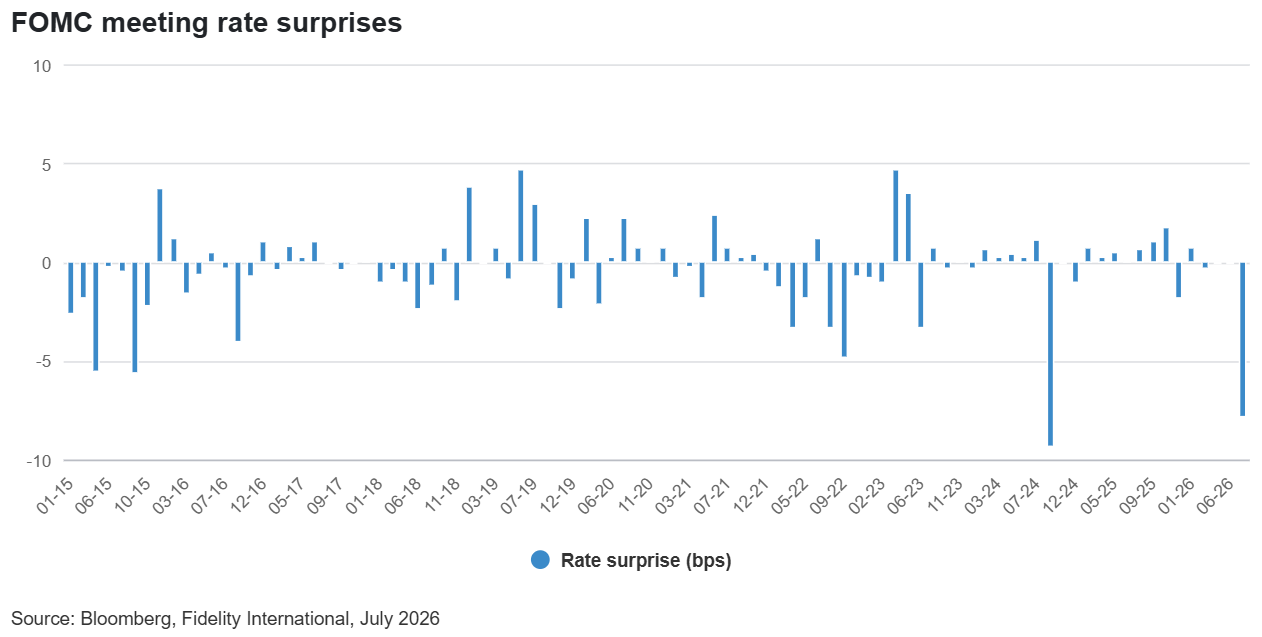
The episode reinforces what we see as a new regime of elevated macroeconomic volatility. Without a clear policy anchor, markets are increasingly likely to react to their own interpretation of economic and geopolitical developments, resulting in sharper moves across the yield curve.
This dynamic was reflected in yesterday's price action, with a clear steepening bias in bonds. While the shorter end rallied, still anchored by the dovish pushback from Warsh's press conference, the longer end sold off, becoming increasingly untethered from the Fed. The sell off in the longer end was largely driven by a rise in inflation breakevens, reflecting a loss of confidence in the Fed's ability to maintain price stability. We think this puts increasing pressure on Warsh to back his rhetoric with action and raises the risk that the Fed may have to hike sooner if oil prices and inflation pressures continue to build.
However, our base case remains that the Fed will begin its hiking cycle in December. Our read on Warsh is that, despite his hawkish rhetoric on inflation, he may ultimately prove to be more dovish than his comments suggest, particularly with the US midterm elections approaching. The task force recommendations, expected in the autumn or by year end, provide useful cover for maintaining the current policy stance in the meantime. Moreover, the US Bureau of Economic Analysis (BEA) methodology changes due to take effect at the end of September are likely to take some of the heat out of inflation data. We estimate these changes could reduce core PCE by around 30 basis points relative to our year end expectations, easing the pressure for earlier rate hikes.
Markets have already reduced the probability of a September hike and are increasingly aligning with our view on the timing of the next move. Over the coming months, we will continue to monitor incoming economic data and geopolitical developments, both of which remain critical to the path of monetary policy. We will also be watching closely how the relationship between Warsh and the rest of the Committee evolves. We note the Fed remains quite divided and will need to see which way the “family fights” break out ahead.