This article first appeared in Livewire on 12 March 2025
Everyone knows what a blue chip company is – or do they? Often as not, they are the largest companies by market capitalisation, have decades of experience and pay large and consistent dividends. These are stable companies, we expect them to endure and while they aren’t usually cheap to buy, they are typically core parts of an equity portfolio.
Historically, the likes of big banks (Wells Fargo, Bank of America, Commonwealth Bank) would fall in this category, some large-scale consumer products (think Nestle) and healthcare (i.e. Proctor & Gamble or Johnson & Johnson). In Australia, you can also add big miners, such as BHP and Rio Tinto to the list.
In recent decades, tech giants have entered the fray, in the form of Microsoft and Apple. Investors may also ponder the likes of Amazon, TSMC and Nvidia.
The world of AI is throwing up a lot of change in the world and threatening the status of a range of companies. In light of that, it seemed timely to revisit what makes a company a blue-chip and ask fund managers for some of the gems they consider blue chips that investors might not typically look at.
In the first part of the discussion, I’ll look at global companies – those who have been debating valuations and fundamentals, particularly in US large-cap markets – this one is for you. In part two, I’ll look at Australian blue-chips.
To help me in the discussion for global companies, I spoke to:
- William Liu, Wilson Asset Management
- Matt Jones, Fidelity International
How to define a blue-chip
Jones cautions against a rigid idea of what is and isn’t a blue-chip as it depends on individual needs and circumstances.
“Traditionally, you could say it simply means ‘safe’, large capitalisation, stable earnings of good quality and management,” Jones says, adding that this view should be expanded in today’s environment to include adaptability, resilience and limited outlier risks.
Liu’s definition considers competitive advantage and a structurally advantaged industry.
“I advocate for identifying businesses protected by high barriers to entry like irreplaceable assets, mission-critical IP, and network effects. These characteristics preserve pricing power and enable the generation of excess profits by insulating the firm from competition,” Liu says.
Both use fundamental analysis as part of their checklist, with the typical criteria like a strong balance sheet, stable earnings and monitoring capital expenditure and expected returns.
The growth of AI requires an added layer of judgement.
“Investors must critically assess whether the proliferation of artificial intelligence serves as a strategic moat-widener or a disruptive threat to a company's long-term viability,” says Liu.
Three global blue-chips for your portfolio
To be a blue-chip, a company doesn’t necessarily need to be the largest company on a stock exchange. With that in mind, I tasked the fund managers with offering up a few ideas of companies they considered to be blue chips, regardless of capitalisation.
While one is an unsurprising favourite, the other two suggestions may not have been on your radar.
1) Microsoft (NASDAQ: MSFT)
Nominated by Jones
Source: Trading View, 7 March 2026
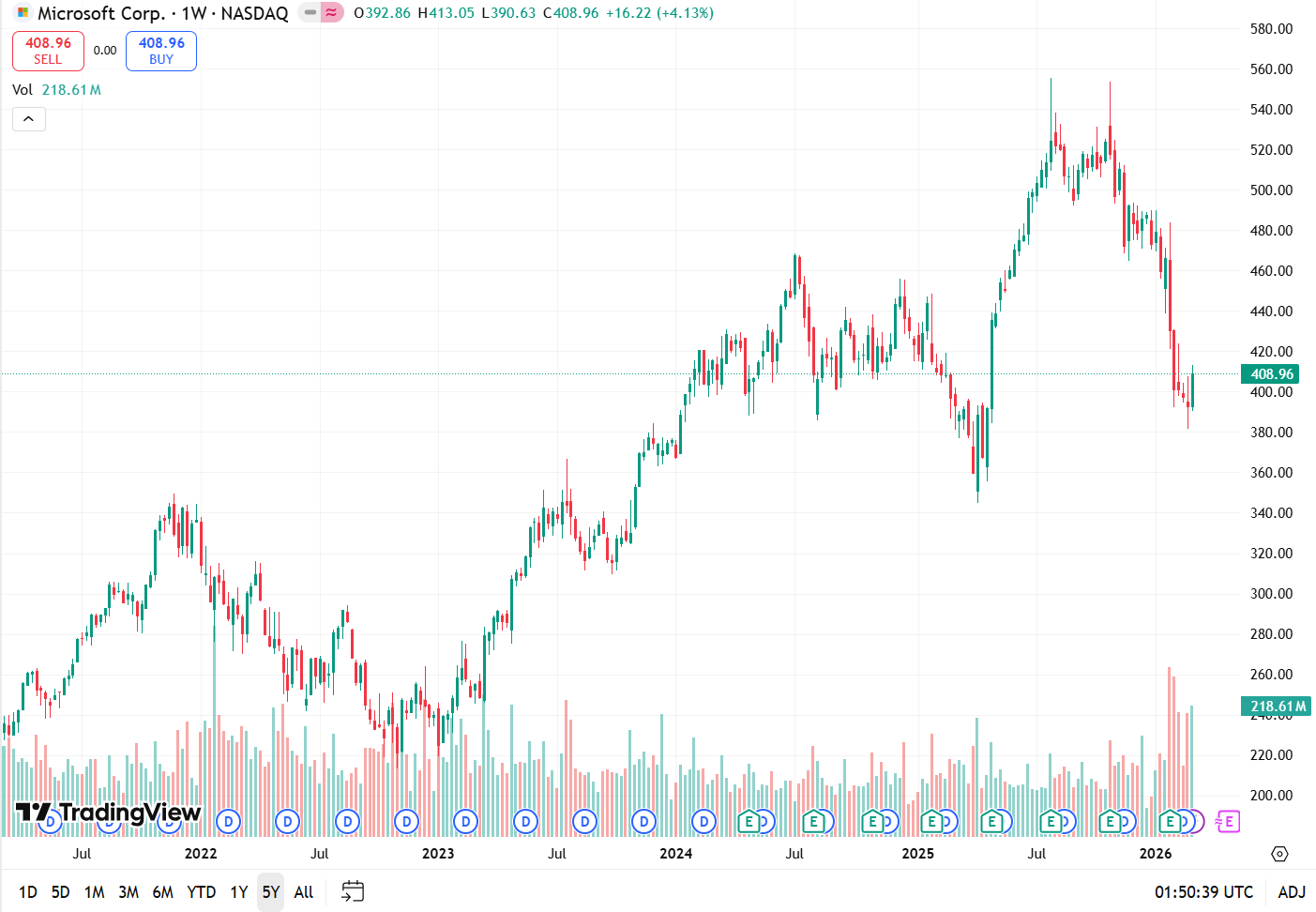
Microsoft outperformed in its latest quarterly earnings report, beating market consensus for its revenue and earnings per share. Investors were concerned about the heavy capex into AI and share prices initially fell by 10%. It has recovered since then, but is still trading below the record highs over $500 (which it hit in late 2025).
Broker consensus is typically favourable for Microsoft, with the likes of Goldman Sachs and UBS positioning it as a Buy, with both setting a price target of $600.
“Microsoft is a standout candidate, especially when you think of solid earnings, free cash flows and general quality of its P&L and balance sheet,” says Jones.
“More specifically, it is very resilient. The company was seen as a dinosaur with a redundant and old operating system in the 2010s, but with a pivot to subscription services, Microsoft 365, Azure Cloud, AI, and Copilot, it is leading the transformation.”
2) Amrize (NYSE: ARMZ)
Nominated by Liu.
Amrize provides building solutions in North America in the form of building materials, like cement or asphalt, along with advanced roofing and wall systems, such as insulation or sealants.
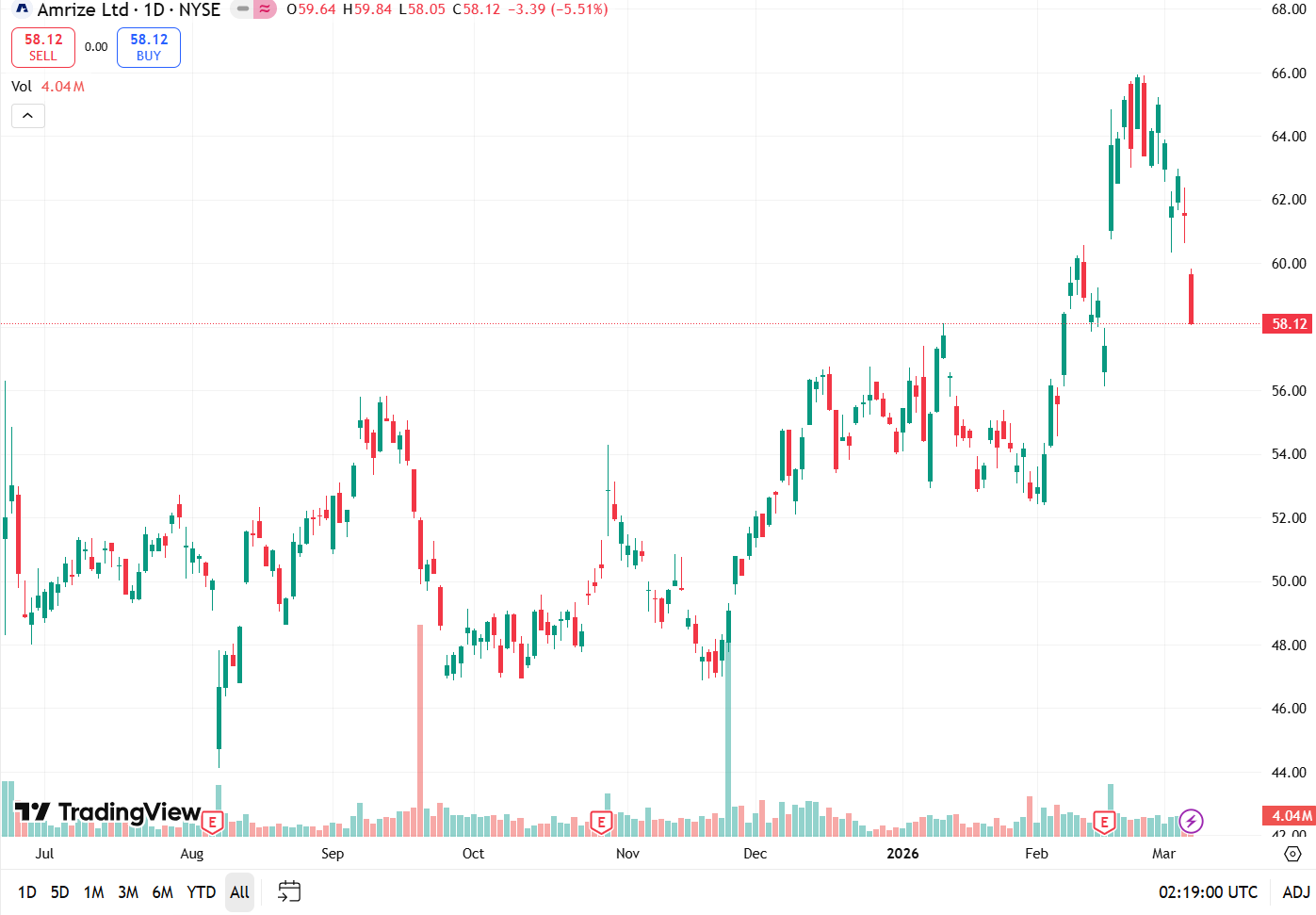
It was listed on the New York Stock Exchange and the Swiss exchange in June 2025 and was spun off from Holcim, a Swiss-based building construction materials firm.
Source: Trading View, 7 March 2026
Broker consensus is a BUY, and both Deutche Bank and JP Morgan recently increased their price targets for Amrize to $70 (from $59 and $60 respectively).
Liu notes that Amrize has a leading position across cement, aggregates and building envelope solutions in North America, along with a logistics network over 1,000 sites across US and Canada.
“There is a significant barrier to entry due to the stringent permitting requirements for cement and aggregates. Amrize’s leadership position in inland markets gives it pricing power evidenced through the company’s industry leading margins,” Liu says.
He also highlights Amrize’s intellectual property in advanced roofing systems and the strength and experience of its management team.
“Additionally, it trades at an attractive valuation to its peers, and we see positive catalysts including smaller tuck in acquisitions, returns of capital to shareholders and the realisation of cost savings as an independent company.”
3) Linde PLC (NASDAQ: LIN)
Nominated by Jones.
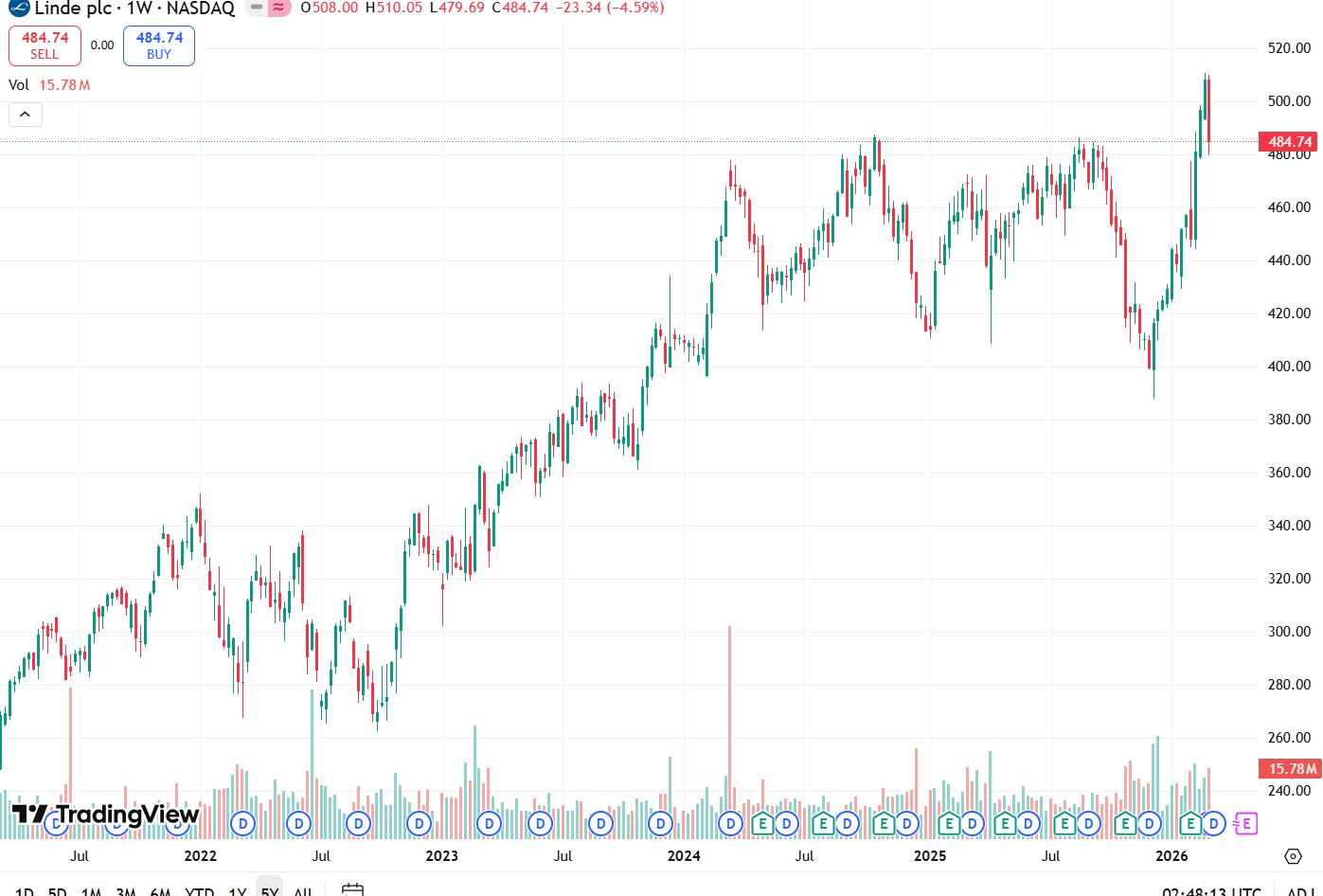
Linde is a UK-domiciled chemical company and the world’s largest industrial gas supplier. Share prices were rattled in the last week, off the back of the surge in oil and gas prices relating to the tensions in the Middle East.
Source: Trading View, 7 March 2026
Broker consensus is largely positive towards Linde. Morgan Stanley has an overweight rating on the stock, with a price target of $530, while JPMorgan is neutral on it.
“It’s a long-term quality compounder, an industry leader of the highest quality with superior margins, solid cash flows and typically longer embedded contracts for that stability and somewhat stickiness due to higher switching costs,” Jones says.
“Industrial gasses might be seen as slow growers but with local monopoly, like pricing power boosting margins, and the space opportunity with SpaceX, this is an adaptable and resilient business.”

