At this year’s Jackson Hole conference, US Federal Reserve (Fed) Chair Kevin Warsh gave markets what they had been looking for - a semblance of framework guidance - restoring his credibility while also teeing up the risks of rate hikes in the interim. We hold our view that the Fed will start hiking only from December post mid-term elections.
What happened?
Kevin Warsh’s opening speech at Jackson Hole ended up doing some damage control after his previous transgressions towards markets. While he stuck to his broad principles of no forward guidance, price stability, focus on the supply side, AI, etc., he struck a better balance and gave markets more to digest than he had previously.
His hawkish comments on inflation were backed by some framework guidance on how he is reading underlying inflation, namely, the percentage of Personal Consumption Expenditures (PCE) components running above 3 per cent, inflation-expectation measures such as compensation from swaps markets, and a clearer assessment of the economy and labour market, which he characterised as consistent with full employment and not a source of concern for the Fed. More importantly, he reaffirmed PCE as the Fed’s “firm fixed measure” for its 2 per cent inflation target, cleaning up his comments from last time.
At the same time, he maintained his tough stance on inflation, downplaying the progress in recent prints and delivering a more forceful message that the Fed will have “work to do” if underlying inflation does not move towards its objective. He also offered useful clarity elsewhere, including that “short-term interest rates are the predominant tool to achieve the dual mandate” and that on balance financial conditions were not restrictive. Taken together, these were subtle but important shifts, enough to win back some market approval and restore part of the credibility lost over the past month.
The high-stakes data due over the next two weeks has the potential to tilt a very divided Fed.
Our interpretation
Warsh went beyond his usual communication style at Jackson Hole and offered markets some semblance of the framework guidance he has avoided in the past. We have argued that while forward guidance holds less value in today’s uncertain environment, some framework guidance, or a clearer Fed reaction function, remains imperative for orderly market functioning.
Market reaction was clear in its verdict. The dollar strengthened by more than half a percent after his speech, taking some shine away from gold (down more than 1 per cent) as the safe-haven choice. In bond markets, we saw a clear flattening trade, with the short end selling off on the hawkish rhetoric while the longer end was less affected. Yields in the 20- to 30-year segment eased somewhat after his speech, taking some edge off the term premium at the long end.
While Warsh’s speech has helped restore his credibility with markets, it also opens the door to a potential September hike if the data continues to come in stronger. His preferred measure of underlying inflation, the percentage of disaggregated PCE components running above 3 per cent, remains well below its 2022 highs but has been rising over the past year, standing at 54 per cent and 48 per cent on a 12-month and 6-month annualised basis, respectively. This contrasts with other measures of underlying inflation, including the Dallas Fed trimmed mean, Cleveland Fed Median PCE and New York Fed Multivariate Core Trend, which have shown a relatively clearer disinflationary path and are used by some Fed officials.
Percentage share of US PCE components with year-on-year change above 3%
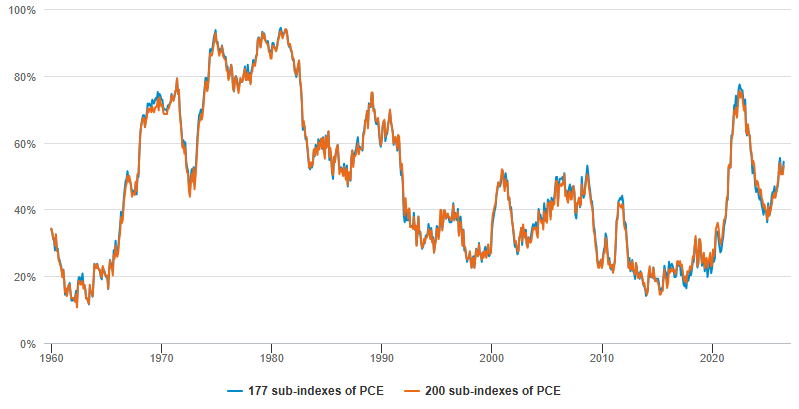
Source: Fidelity International, Bureau of Economic Analysis, Dallas Fed, Cleveland Fed, August 2026.
Note: The 177 PCE sub-indexes are based on Dallas Fed disaggregation, and the 200 sub-indexes are based on Cleveland Fed disaggregation.
Looking ahead
Market odds of a September hike have risen to more than 60 per cent, but another full round of labour market and inflation data is due before the Fed meets in mid-September. We continue to hold our view that the Fed will remain on hold in September and only hike from December, after the US mid-term elections.
While Chair Warsh is sounding more hawkish on inflation, we still believe the majority of Fed voters are likely to have been more receptive to the recent improvement in the data, as inferred from the latest minutes. The US Bureau of Economic Analysis (BEA) methodology revisions due in September also skew more disinflationary and should buy the Fed more time to stay on hold and remain in data-watching mode.
That said, this remains a close call. The high-stakes data due over the next two weeks has the potential to tilt a very divided Fed. We will also be watching the final round of Fed speak ahead of the blackout period next Saturday, including Governor Christopher Waller, who we believe has shifted towards the centre of this committee.