Almost a century ago, economist John Maynard Keynes compared investing in the stock market to a newspaper beauty contest. The objective wasn’t to select the most attractive face, but rather to predict which face other contestants would find most attractive.
It’s a useful analogy for how financial markets operate. In theory, the value of a company should reflect the cash flows it can generate over its lifetime. In practice, its share price is determined by what other investors are willing to pay for it today. These two things don’t always align.
Lately, I’ve been wondering whether the gap between the two is becoming more pronounced. Not necessarily because investors have become less rational, but because the way capital is allocated across financial markets has changed significantly.
This raises an interesting question: are share prices increasingly being driven by capital flows rather than business fundamentals?
Key takeaways
- Capital flows may be playing a bigger role in driving share prices. The rise of passive investing and market-cap-weighted strategies may be amplifying market movements, with capital increasingly flowing towards the largest companies regardless of individual valuations.
- Market concentration isn’t just about fundamentals. While today’s market leaders are supported by strong earnings and competitive positions, their share of global equity market capitalisation has grown faster than their contribution to earnings, raising questions about valuations and future returns.
- Fundamental research may uncover opportunities beyond the market leaders. As capital becomes increasingly concentrated, under-researched small and mid-cap companies may offer opportunities for investors able to identify businesses whose improving fundamentals are not yet reflected in share prices.
The passive revolution
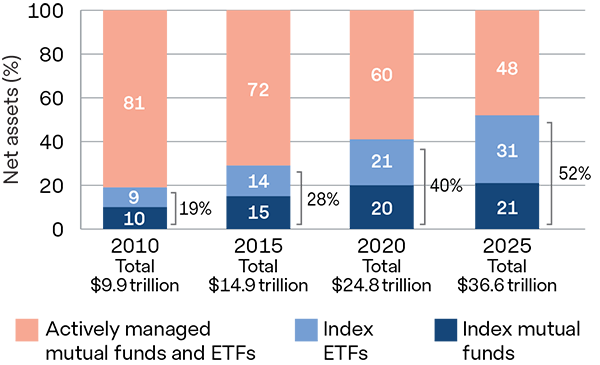
One of the most significant developments in financial markets over the past two decades has been the relentless rise of passive investing. The statistics are quite remarkable. According to the Investment Company Institute (ICI), index mutual funds and ETFs accounted for just 19% of US long-term fund assets in 2010. By the end of 2025, that figure had climbed to 52%.1
Figure 1. Index funds have grown as a share of the fund market
Percentage of long-term fund total net assets, year end
Note: Data exclude money market funds. Data for ETFs exclude commodity ETFs.
Source: The Investment Company Institute (ICI), 2026 Investment Company Fact Book.
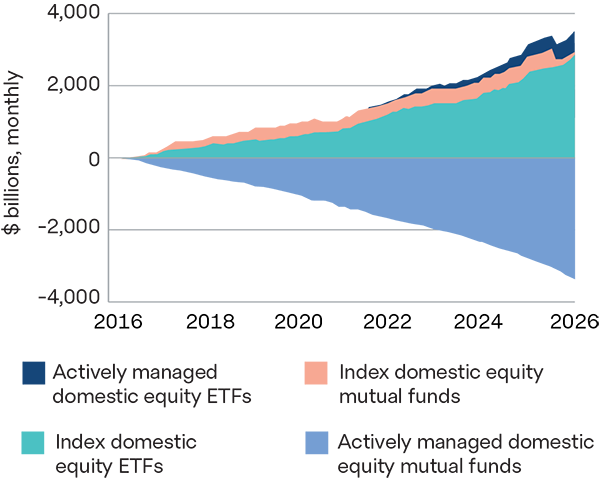
Perhaps even more interesting is where the money has been going. Over the decade ending December 2025, US domestic equity index funds attracted approximately US$2.9 trillion in net inflows and reinvested dividends. Meanwhile, actively managed domestic equity mutual funds experienced approximately US$3.4 trillion in net outflows.2
The scale of the shift is striking, with inflows into passive index funds broadly mirroring outflows from actively managed funds (see Figure 2).
Figure 2. Some mutual fund outflows have shifted to ETFs
Cumulative flows to domestic equity mutual funds and net ETF issuance
Note: Mutual fund data includes net new cashflow and reinvested dividends; ETF data for net share issuance includes reinvested dividends.
Source: The Investment Company Institute (ICI), 2026 Investment Company Fact Book.
That’s a substantial shift in how investors allocate capital. To be clear, there are very good reasons for this development. Index funds offer low fees, broad diversification and a convenient way for investors to participate in financial markets. For many investors, they represent an entirely sensible investment solution. After all, Warren Buffett has long recommended low-cost S&P 500 Index funds for most investors, and he even famously bet US$1 million in 2007 against Protégé Partners that the S&P 500 Index Fund would outperform a collection of hedge funds (chosen by Protégé Partners themselves) over a decade, and he was correct.
But there’s an important aspect worth exploring further. When investors allocate money to an actively managed fundamental strategy, the portfolio manager typically assesses the earnings prospects, financial position and valuation of each company before deciding whether to invest. When money flows into a market-capitalisation-weighted index fund, no such company-specific valuation assessment is required. The capital is allocated according to the existing weights of the companies within that index.
Which brings us to an interesting question: What happens to price discovery when an increasing proportion of investors aren’t making independent judgements about what individual businesses are worth? Passive investing rests on the efficient market hypothesis, namely, that stock prices already incorporate all known data, and this is made possible by active managers. In effect, passive investing ‘free rides’ on active investing engaging in price discovery. Remove active managers from this equation and we get back to the question of what happens to price discovery?
The marginal buyer matters
One of the more fascinating characteristics of stock markets is that the price of an entire company is determined by transactions involving only a small fraction of its shares. Consider a company with 100 million shares outstanding. If buyers are willing to pay 2% more for a relatively small parcel of shares (say 5,000 shares), the market value of the entire company can increase by 2%, even though the vast majority of shareholders haven’t traded. This is where the relationship between capital flows and share prices becomes interesting.
In a 2021 research paper, economists Xavier Gabaix and Ralph Koijen investigated what they called the ‘inelastic markets hypothesis’.3 Their research estimated that each additional dollar invested in the aggregate stock market could increase its total market value by approximately five dollars. It doesn’t mean every dollar invested in an index fund automatically generates five dollars of market capitalisation. Rather, it illustrates how sensitive asset prices can be to changes in demand when existing shareholders are unwilling or unable to accommodate that demand without a price adjustment.
Now consider the implications for a market increasingly dominated by benchmark-aware investors. An index fund doesn’t automatically purchase additional shares simply because a company’s price appreciates. However, as its market capitalisation rises, it receives a larger allocation of subsequent inflows into market-cap-weighted strategies. Meanwhile, active managers may become increasingly reluctant to underweight the largest companies, particularly when doing so introduces substantial tracking error against their benchmarks. The combination can potentially reinforce existing market leadership.
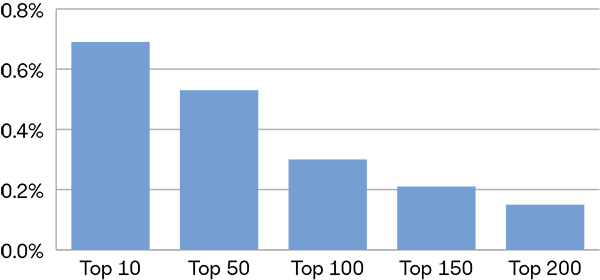
Research published in 2025 by Jiang, Vayanos and Zheng found evidence that passive fund inflows disproportionately increase the share prices of the largest companies,4 particularly those already experiencing strong investor demand. As we can see from Figure 3 below, increased flows into the S&P 500 Index have more pronounced positive effects on the largest ten companies than on any other cohort. Size begets flows; flows beget size – and the cycle becomes self-reinforcing.
Figure 3. Quarterly excess return vs S&P 500
Source: FIL, Jiang, Vayanos & Zheng (2025), ‘Passive Investing and the Rise of Mega-Firms’, The Review of Financial Studies, Volume 38, Issue 12.
Of course, there’s an important counterargument. Despite representing the majority of US domestic equity fund assets, index mutual funds and ETFs held only around 19% of the total US stock market at the end of 2025. Other investors (households, hedge funds etc.) still own the majority of equities, and many continue to make active decisions about valuation.
Nevertheless, the research suggests capital flows may have a disproportionate influence on share prices even when passive investors represent a relatively small share of the overall market ownership.
Is this helping explain today’s market concentration?
In recent years, much has been written about the extraordinary concentration of global equity markets. At 30 September 2026, the ten largest securities in the MSCI World Index represented almost 28% of its total market capitalisation. That’s an enormous amount of exposure concentrated in a relatively small number of businesses.
Table 1. MSCI World Index top ten
| Name | Weights (%) |
| NVIDIA Corp | 5.81 |
| Apple Inc | 5.41 |
| Microsoft Corp | 4.00 |
| Amzon.com Inc | 2.67 |
| Alphabet Inc (Class A) | 2.23 |
| Alphabet Inc (Class C) | 1.76 |
| Meta Platforms Inc | 1.76 |
| Broadcom Inc | 1.76 |
| Micron Technology Inc | 1.33 |
| Tesla Inc | 1.12 |
Source: MSCI World Index Factsheet, 30 September 2026.
Now, it’s important not to confuse concentration with irrational exuberance. Many of today’s market leaders are exceptional businesses. They generate substantial earnings, enjoy strong competitive positions and have delivered remarkable growth. Indeed, their superior fundamentals explain a significant part of their share-price appreciation. But there’s a difference between a great business and a great investment. The latter depends not only on what a company earns, but also on the price investors pay for those earnings.
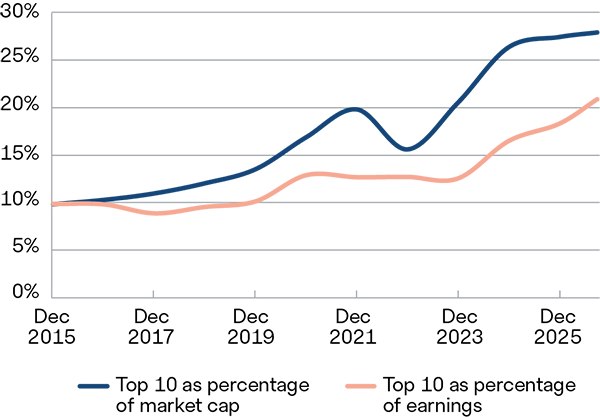
One particularly useful way to assess market concentration is to compare the share of total market capitalisation represented by the largest companies with their contribution to aggregate corporate profits. If market-capitalisation concentration rises alongside earnings concentration, that’s largely consistent with fundamentals driving prices. But if market values rise substantially faster than profits, valuation expansion is doing some of the heavy lifting.
As Figure 4 below shows, the top ten stocks within the MSCI World Index account for almost 28% of its market capitalisation, but just 21% of total earnings. That gap has generally widened over time.
Figure 4. MSCI World Index: Market capitalisation vs. total earnings, (December 2015 – September 2026)
Source: FIL, Bloomberg.
We’ve seen the consequences of this before. During the late‑1990s dotcom boom, investors correctly anticipated that the internet would transform the global economy. Where many went wrong was in extrapolating that opportunity into valuations that assumed extraordinary future success. The technology was real. The expectations embedded in share prices were sometimes the problem.
Today’s environment isn’t identical. However, it does raise an important question about the extent to which flows are reinforcing fundamental success, and whether investors are increasingly paying for future growth well before it materialises.
Where might the opportunities lie?
For fundamental investors, these developments have important implications. As more capital flows into index‑tracking and systematic strategies, companies receiving less investor attention may become more susceptible to valuation
dislocations. This could be particularly relevant across global small- and mid-cap equities. These businesses typically receive less analyst coverage, have lower trading liquidity and represent relatively small weights within broader equity benchmarks. Some may also be underrepresented in the largest pools of index-tracking capital.
Now, that doesn’t automatically make them attractive investments. Smaller companies can carry greater financial, operational and liquidity risks, which may justify lower valuations.
But consider a hypothetical company whose earnings expectations have been steadily increasing, whose returns on invested capital remain attractive, and whose balance sheet is sound. If its share price has gone nowhere despite those improvements, the disconnect deserves investigation.
Conversely, consider a business whose share price has appreciated substantially while earnings expectations have barely changed. Its prospective investment returns may depend increasingly on investors continuing to award it a higher valuation multiple.
Neither situation guarantees what happens next, but the distinction is important. For investors prepared to undertake independent fundamental research, the opportunity is to identify businesses where improvements in economic value are not yet adequately reflected in share prices.
The challenge, of course, is timing. A fundamentally undervalued company can remain undervalued for an extended period, particularly when capital continues flowing elsewhere. Being correct about intrinsic value doesn’t necessarily mean being rewarded immediately.
That’s why business quality, balance-sheet strength, sustainable cash generation and management quality, amongst other things, remain so important. They give investors greater confidence that the business can continue creating value while they wait for market expectations to catch up.
The price of everything and the value of something
None of this suggests that passive investing is inherently problematic, or that fundamentals have somehow ceased to matter. Capital flows have always influenced financial markets. And much of today’s market leadership is supported by genuine improvements in earnings, profitability and competitive positioning.
What may be changing is the extent to which flows amplify those developments, potentially pushing valuations further away from underlying fundamentals, and keeping them there for longer than investors might expect.
For asset allocators, that raises questions about diversification and the risks embedded in increasingly concentrated market-cap-weighted portfolios. For fundamental investors, it reinforces the importance of distinguishing between what the market is currently rewarding and what businesses are actually delivering.
Ultimately, capital flows can influence the price investors are willing to pay for a company. But they cannot, by themselves, determine how much that company will earn over the next decade. And therein lies the opportunity.
If fewer investors are asking what a business is actually worth, the answer to that question may become increasingly valuable to those who are prepared to do the work.