Improving earnings prospects, technological leadership and attractive valuations are strengthening the investment case for China, putting Asia’s largest economy back on the radar of global investors. Fidelity portfolio managers Tina Tian and Dale Nicholls discuss the evolving opportunity set, including how changing consumption patterns are creating a new generation of potential winners.
Key points
- China remains under-owned by global investors, despite improving fundamentals and attractive valuations.
- While the macro picture remains mixed, the strength and competitiveness of Chinese companies are often overlooked.
- China's growth opportunity is broadening beyond traditional consumption, supported by innovation, industrial upgrading, electrification and healthcare. Changing consumption patterns are also creating a new generation of winners.
China remains out of favour with many global investors. Concerns around domestic growth, the property sector and geopolitics have weighed on sentiment, leaving many investors underweight the market. Yet we believe the investment case has strengthened over recent times.
Global fund allocations to China remain well below benchmark, despite the country's significance within the global economy. While earnings growth has been relatively subdued over the past decade, valuations have fallen to levels that we believe do not fully reflect the long-term prospects for many Chinese companies. Today, the market trades on around 10 times forward price-to-earnings, well below its historical average and providing a large discount to some developed markets. We believe this creates scope for both earnings and valuations to improve over time.
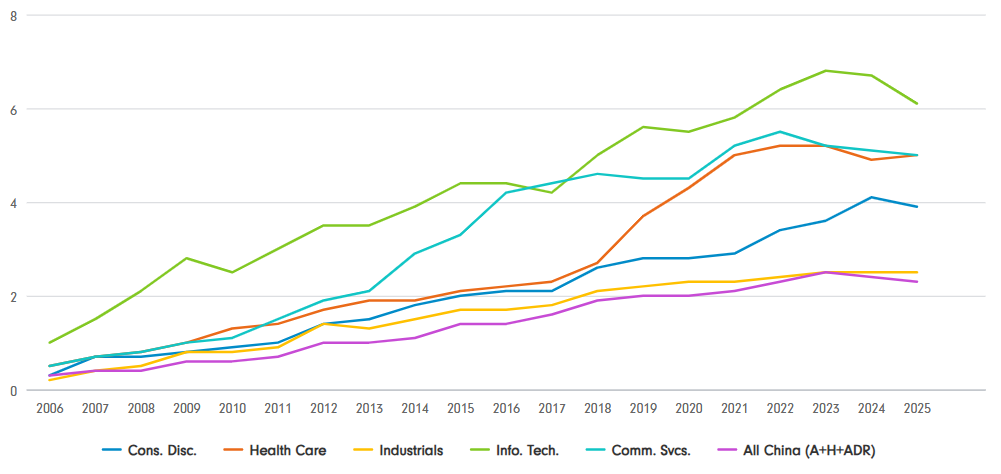
When discussing China, it is easy for the narrative to become dominated by macroeconomics and geopolitics. While these remain important considerations, we believe the more interesting story lies with the companies themselves. Across many sectors, Chinese businesses continue to invest in research and development (R&D), strengthening their competitive positions and gaining market share globally. Opportunities are emerging from industrial and broader innovation related sectors beyond traditional consumption. Those are the trends that continue to shape how we think about the opportunity set in China.
A two-speed economy
China's economy is operating at twin speeds. Domestic consumption has remained relatively weak, while exports have shown considerable strength. At the same time, we are beginning to see signs that capital investment is picking up, particularly in areas linked to artificial intelligence and broader technology innovation. China has lagged the US in AI investment, but this is an area we believe is worth watching as investment gathers pace.
Consumers reluctant to spend
Source: Fidelity International, National Bureau of Statistics, Macrobond, July 2026.
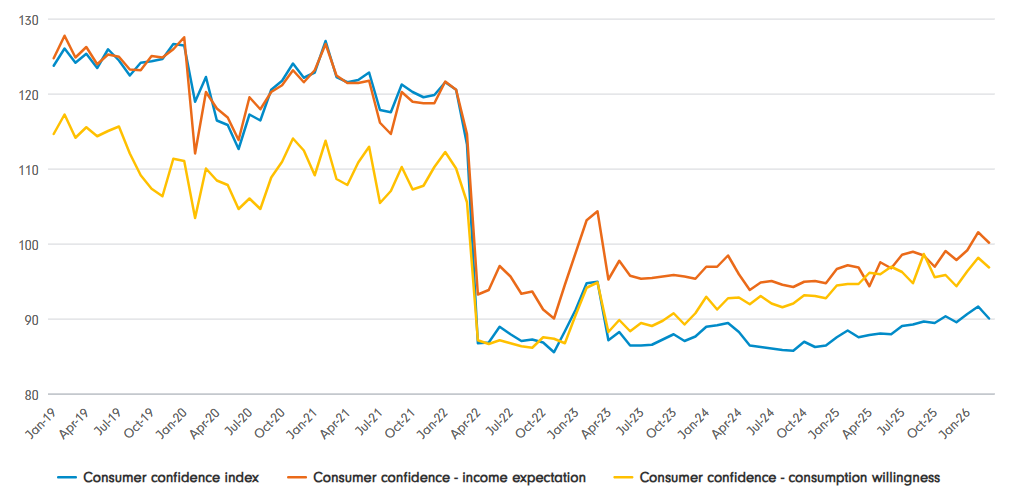
While exports have supported growth, domestic demand has remained more subdued. Consumer confidence has yet to recover fully following the pandemic. Despite relatively healthy household balance sheets, consumers are reluctant to spend, leading households to save more and borrow less. In our view, the issue is less about consumers' ability to spend but more about confidence.
Two factors are likely to be particularly important in rebuilding that confidence. The first is income expectations. Here, there are some encouraging early signs, with employment indicators beginning to improve. The second is asset prices, particularly housing. Property remains central to consumer confidence in China and continues to be one of the biggest drags on the economy.
Our view on the property market remains somewhat different from the prevailing consensus. Housing starts have fallen by around 80% from their peak, representing a significant adjustment in supply. Historically, property corrections have tended to follow a similar pattern, lasting around five years with prices falling by 30% or so. We believe China is now approaching the latter stages of that adjustment.
While government measures have helped support demand through lower financing costs, we believe the more important adjustment has been on the supply side. Over time, this reduction should help restore a healthier balance between supply and demand.
Importantly, we do not necessarily need to see a sharp recovery in property prices. Greater stability alone could help restore confidence and encourage a gradual recovery in consumption. Combined with healthier household balance sheets and early signs of improvement in employment, these developments suggest that parts of the domestic economy are beginning to evolve, even if the recovery remains gradual.
The macro picture therefore remains mixed, and we are not suggesting that China's economic challenges have disappeared. However, focusing solely on these issues risks overlooking the developments taking place beneath the surface.
The overlooked strength of Chinese companies
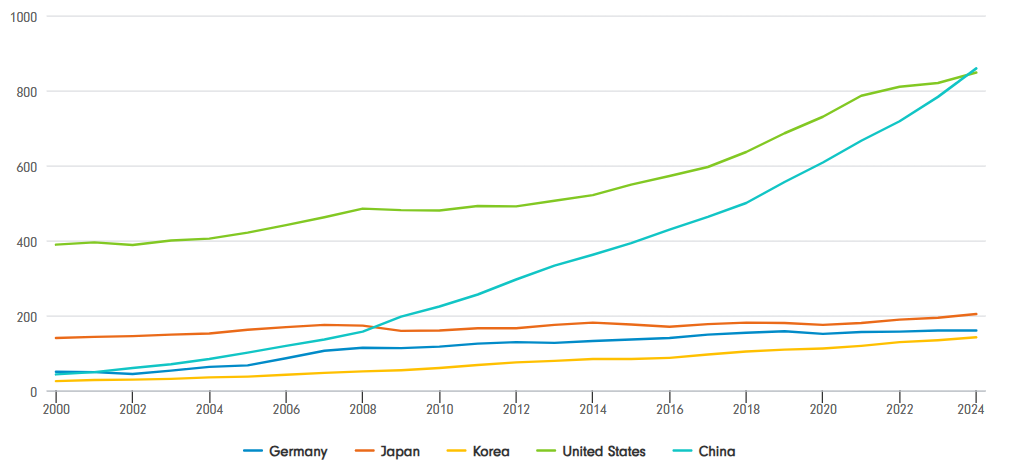
For us, the more compelling story continues to be found at the company level. Across many industries, Chinese businesses are strengthening their competitive positions through sustained investment in R&D, manufacturing expertise and the scale advantages that come from serving one of the world's largest domestic markets.
Although R&D investment has weighed on margins, it has delivered in terms of innovation and market leadership. This is something we continue to see first-hand through our meetings with management teams and remains an important factor when assessing the long-term outlook for many businesses.
Growing competitiveness supported by R&D
Billion US dollar, purchasing power parities (PPP) converted
Source: OECD, March 2026 statistical release with full-year 2024 data.
Increasing R&D in China across sectors
Source: Goldman Sachs Global Investment Research, May 2026
Scale is another advantage that we believe is sometimes underestimated. Companies that can build products for China's domestic market benefit from production volumes, operational expertise and supply chain ecosystems that are difficult to replicate elsewhere. In many industries, this provides a strong platform for international expansion and helps explain why Chinese companies continue to gain market share globally.
We also see encouraging signs in the way companies are allocating capital. For many years, Chinese businesses were net issuers of shares. More recently, buyback activity has increased meaningfully while dividend payments have continued to grow, supported by corporate governance reforms that are placing greater emphasis on shareholder returns.
Opportunities beyond traditional consumption
Given this backdrop, it is important to highlight that China’s investment opportunity is extending well beyond traditional consumption into areas such as innovation, industrial upgrading, electrification, healthcare and wellbeing. At the same time, the consumer landscape itself is evolving, with changing spending patterns and new business models creating a different generation of potential winners.
Electrification is one area where we continue to see attractive long-term potential. CATL is a good example. The company has built a strong competitive position through technology, manufacturing scale and continued investment in innovation. Electric vehicle (EVs) remain an important source of demand, but the opportunity is broadening. Energy storage is becoming increasingly important as electricity demand grows and renewable generation expands, while over the longer term we expect electrification to extend further into commercial vehicles, industrial equipment and potentially robotics. This creates multiple sources of growth beyond passenger EVs alone.
We are also looking closely at how AI moves from infrastructure into real-world applications. Much of the market's attention has focused on large language models and the hardware required to train them. Over time, however, we believe real-life applications such as robotics and autonomous driving could become increasingly important. China has strengths across several parts of this ecosystem, including manufacturing, supply chains, AI development and access to real-world application scenarios. Humanoid robotics, for example, remains at an early stage commercially, but growing deployment in industrial settings could create opportunities across a much broader manufacturing value chain.
Healthcare and biotechnology represent another area where China's innovation capabilities are becoming increasingly visible globally. International pharmaceutical companies are showing greater interest in innovative drug assets developed in China, reflected in growing licensing activity. We believe this demonstrates the improving quality of China's R&D ecosystem. Healthcare is ultimately closely linked to people's quality of life, with needs evolving throughout the life cycle – from prevention and wellness to treatment and healthy ageing – creating long-term opportunities that extend well beyond traditional consumption.
Consumer spending patterns are also evolving around experiences, value for money and products that offer a stronger emotional connection. Discount snack retailer Busy Ming is one example. Its affordable, small pack products and constantly changing range create a “treasure hunt” shopping experience. This illustrates an important point. Subdued consumer confidence does not mean there are no areas of growth. Rather, consumers are becoming more selective about where and how they spend.
At the same time, we continue to find opportunities in more traditional consumer industries where expectations are already low. In areas such as dairy and hog farming, industry conditions have been challenging due to pricing cycle, but the resulting supply adjustment could create opportunities for stronger companies as pricing and profitability begin to stabilise. Rather than relying on a broad-based recovery in consumption, our focus is on identifying individual businesses that can emerge stronger from this cycle.
We take a similarly selective approach to property. The sector continues to face structural challenges, but that does not mean every company should be viewed in the same way. China Resources Land, for example, has a strong balance sheet and has continued to gain market share as weaker developers have exited, while its investment property portfolio provides a more resilient source of recurring income. We also see the continued development of China's REIT market as potentially supportive of asset recycling and capital efficiency over time.
Taken together, this creates a diverse opportunity set. We are finding businesses exposed to innovation, electrification, healthcare and emerging AI applications, alongside consumer companies adapting successfully to changing spending patterns. Across each of these areas, our approach remains selective, with a focus on company fundamentals, competitive positioning and valuation.
The road ahead
Looking ahead, our outlook continues to be shaped by what we are seeing beneath the surface of the market. There are encouraging signs that investment is beginning to pick up, particularly in industrial innovation and broader consumer technology industries, while household balance sheets remain healthy and the property market appears to be moving towards a better balance between supply and demand.
More importantly, we continue to see Chinese companies investing in innovation, strengthening their competitive positions and competing successfully in an increasingly global industrial landscape. For us, it is these fundamentals that remain the most important part of analysing investment potential. Combined with attractive valuations, the current environment provides rich opportunities to identify businesses that can continue to compound earnings over the long-term and reward investors.