Top regional convictions:
For total return investors:
- Asia’s ‘picks and shovels’ of AI remain attractive. At the same time, recent market volatility reinforces the need for diversification. A barbell strategy combining South Korean and Indian equities makes sense to us.
- Reflation and corporate reforms continue to favour Japanese banks and mid-caps.
For income investors:
- We believe Asian high-yield bonds offer attractive carry relative to developed-market peers, supported by improving credit fundamentals.
For defensive investors:
- Local-currency government bonds in Australia and New Zealand may offer potential diversification and resilience.
The global AI explosion has led to a surge in exports from those Asian countries that produce the technology’s building blocks. But the boom also threatens to widen the gap between economies that can participate in the AI investment cycle and those that can’t.
Governments across the region are fighting to fill the gaps. The drivers of Asia’s economic momentum should therefore broaden in 2027, with a wave of capital spending that seeks to build on the region’s manufacturing strengths.
A capex wave
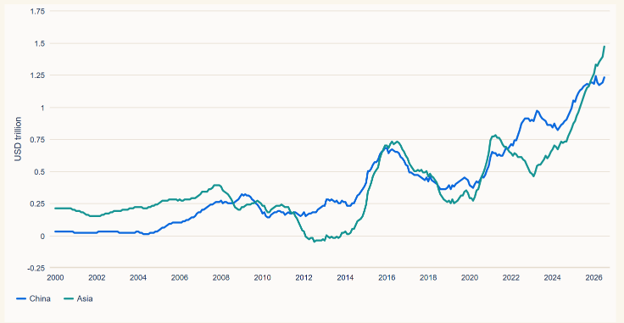
The investment cycle is already taking shape. Asian economies have ramped up investment in AI infrastructure. At the same time, the structural push for supply-chain diversification and economic security is providing more durable support for aggregate demand.
Asia's trade surplus
Source: Fidelity International, Macrobond, IMF, MOF, November 2026
China’s latest Five-Year Plan emphasises a continued shift away from property-led growth towards investment in advanced manufacturing, technology, and new infrastructure. This capex-led model is likely to form a solid base for economic activity in the country in the year ahead.
Japan meanwhile has identified 17 strategic industries where public investment aims to crowd in private capital and rebuild manufacturing capacity over the long term.
South Korea and Taiwan, the region’s semiconductor powerhouses, are capitalising on strong AI-related demand to expand investment across the semiconductor supply chain.
One potential beneficiary of this capex is Japanese automation. “We are seeing a strong recovery in Japan’s automation capex cycle, supported by labour shortages, manufacturing reshoring, and semiconductor investment,” says Kitty Yang, a multi asset analyst who has been looking into global opportunities in robotics and automation.
“Despite a jump in machine tool orders in September and October, Japanese automation names have seen significant valuation de-ratings, creating potentially attractive entry points as earnings recover.”
Alternative paths
The sustained rise in spending could support job and wage growth and, in turn, boost consumption, aiding Asia’s next phase of expansion. But not everyone is winning.
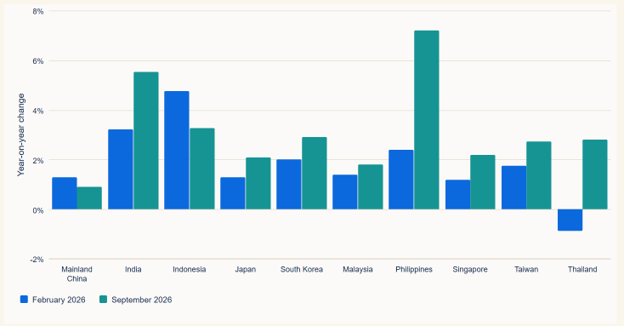
An uneven growth backdrop is likely to lead to diverging monetary policies. The energy shock that rumbled through the region as a result of the chokehold on oil exports in the Gulf earlier in the year, together with the strong investment demand, has pushed up inflationary pressures in much of Asia. But central banks, particularly in economies with tepid growth, confront a difficult trade-off: containing inflation without further weakening domestic demand.
Because much of Asia’s inflation is a result of rising input costs rather than domestic overheating, we expect monetary tightening in the region to be selective in 2027, leading to a broader spectrum of interest rates and currency performance.
Asia inflation accelerates as input costs rise
Source: Fidelity International, Bloomberg, November 2026
China’s two-speed economy is marked by substantial growth in high-tech manufacturing and exports on one side, and a weak property market and subdued consumer spending on the other. Rather than relying on large-scale stimulus, policymakers are directing fiscal resources towards strategic priorities, including technology.
This targeted approach should sustain growth in chosen sectors while providing limited support to the wider economy, keeping inflationary pressures subdued. Given uncertainty over China's domestic demand recovery, we favour areas aligned with Beijing’s priorities, particularly those swept up in the push for greater self-sufficiency.
With Japan emerging from decades of deflation and real wages beginning to rise, the Bank of Japan is expected to continue its gradual policy normalisation. Unlike elsewhere in the region, Japan’s inflation is more home-grown, reflecting rising wages and local demand, which strengthens the case for further rate hikes.
George Efstathopoulos, a Singapore-based multi asset fund manager, is bullish on the outlook for Japanese equities, citing strong earnings growth driven by corporate governance reforms, a competitive currency, and Japan’s important role in global industrial supply chains.
“We particularly favour Japanese mid-cap companies, which are well positioned to benefit from rising real wages and improving domestic demand,” says Efstathopoulos. “We also see opportunities in Japanese banks, where gradually rising interest rates are supporting profitability.”
AI’s next phase
AI adoption is broadening across the region, including in China, where government and corporate efforts to integrate AI into daily life and manufacturing are rapidly diffusing the technology across the domestic ecosystem (for more on the earnings test for AI in 2027 see our equities outlook).
“The AI investment cycle remains structurally intact, with the latest earnings season showing continued progress in cloud revenue growth,” says Joseph Zhang, a multi asset fund manager in Singapore. “Nevertheless, increased scrutiny on the data centre buildout and rising financing costs may lead to some moderation from the previous hype. Hence, selective exposure on high-quality names is increasingly important.”
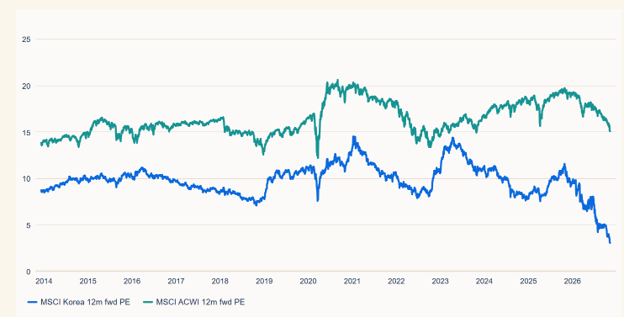
Asia’s ‘picks and shovels’ stocks look compelling following the significant de-rating over the last six months. South Korea’s memory names stand out for their strong earnings outlook and low valuations - if those earnings are delivered. Further corporate reforms are also likely to boost shareholder returns and help narrow the Korean discount.
South Korean stocks' discount to global peers widens
Source: Fidelity International, Bloomberg, November 2026
For those concerned about market concentration, parts of Asia have stepped up as compelling diversifiers. Take India. The market has been out of favour with investors, but with growth underpinned by domestic consumption, infrastructure spending, and services rather than AI capex, it offers an interesting alternative for those seeking returns beyond the tech story. The government’s continued broad-based capex push should support domestic demand, adding to the appeal of Indian equities.
Japanese banks and mid-caps, as mentioned above, could offer another source of diversification, given their greater exposure to the domestic economy versus the global AI cycle.
The refuge of fixed income
If the AI capex cycle slows and weighs on headline GDP growth, bonds could grow in appeal. Within Asia’s fixed income markets, dollar-denominated high yield bonds offer attractive yields relative to developed market peers and a broadly comparable duration profile. Meanwhile, credit fundamentals are improving: the upgrade-to-downgrade ratio has trended higher, while default rates have declined significantly from their 2022 peak. We expect these trends to continue in 2027.
Local-currency government bonds in New Zealand and Australia could also provide diversification. Their relatively strong fiscal positions make them attractive in a world where the government prudence is increasingly being called into question. Fundamentals do not necessarily point to material rate hikes from here, given Australia’s sensitivity to global financial conditions and the continued softness of New Zealand’s economy.
Drive carefully
While our macro forecast remains constructive, there are several hurdles that could see Asia’s growth story veer off course in 2027. A jump in energy prices would fuel inflation across the region, while a severe El Niño, another supply-side shock, could hit Southeast Asia particularly hard, with disruption to agricultural production pushing up food prices and weighing on growth.
China’s manufacturing dominance threatens to exacerbate trade tensions with the EU and US, where policymakers are increasingly focused on protecting domestic industries. Given the deep integration of regional supply chains, these frictions could spill over to the rest of Asia.
And, of course, a slowdown to the AI story would have significant economic implications for semiconductor-heavy economies such as South Korea and Taiwan.
That said, there may be a silver-lining to the AI-led corrections of 2026. If retail enthusiasm moderates, institutional investors are likely to play a greater role in Asian markets, putting a greater focus on fundamentals over momentum.
A widening capex cycle, diverging policy paths, and an evolving AI boom should also create greater dispersion across economies, sectors, and companies in 2027. Taken together, these shifts should make earnings growth, and shareholder returns more important drivers of Asia’s investment performance in 2027.