India's domestic recovery is gaining traction as consumption and capital expenditure improve, while valuations are reasonable and foreign investor allocation is close to trough levels. We have become more constructive on India, with an eye on oil as the key near-term risk. However, we remain positive that India can maintain its 6-7% base rate of growth that’s structural and stable. We continue to believe it remains a stock picker’s market where fundamentals-driven bottom-up research should yield alpha over medium to long term.
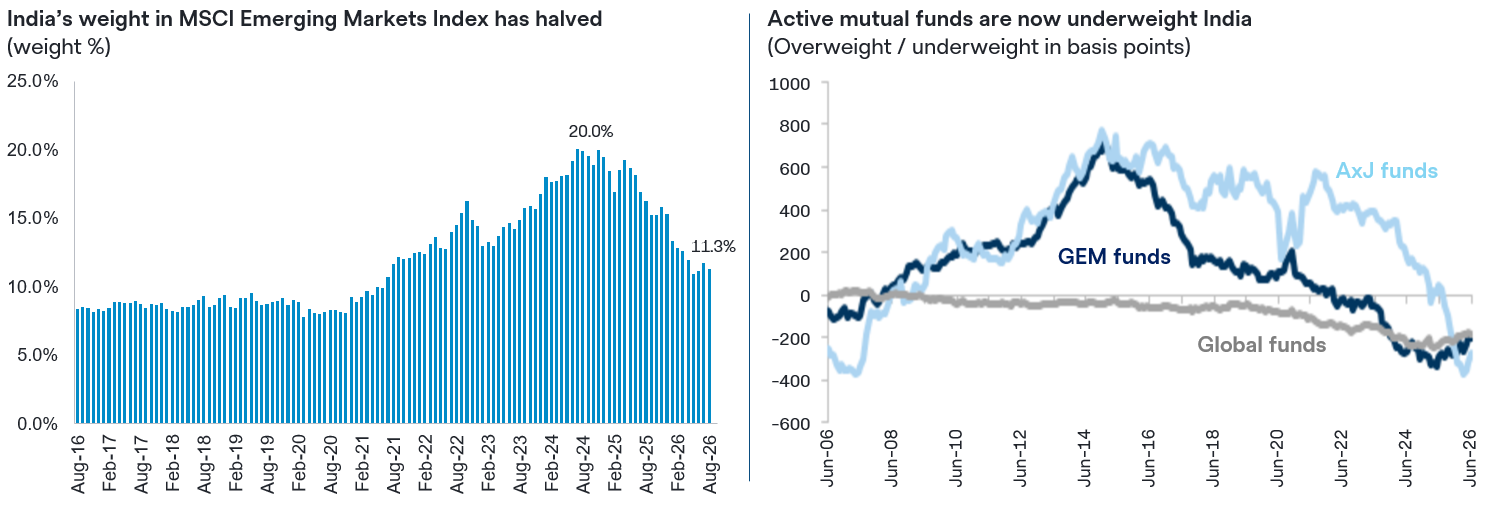
The past two years have seen a significant reset in investor sentiment towards India. A slowdown in economic growth, concerns around higher crude oil prices and uncertainty over the implications of artificial intelligence for employment and job creation have all weighed on sentiment. At the same time, global equity flows have increasingly gravitated towards markets perceived to be beneficiaries of the AI investment cycle. Consequently, India's weight in the MSCI Emerging Markets Index has almost halved in the last 24 months. At the same time global investors, who were broadly overweight India two years ago have now turned underweight.
The relative underperformance of Indian equities has, however, created a healthier starting point for investors. After two years of broadly flat markets and a period of earnings downgrades, India's valuations have moved substantially below their 2024 peaks, both in absolute terms and relative to emerging markets. So, while Indian equities continue to trade above long-term averages, valuations no longer look excessive relative to fundamentals. Additionally, foreign selling disproportionately affected higher-quality large caps, making them relatively more attractive compared to small- and mid-caps which outperformed on sustained inflows from domestic investors.
Chart 1: Active mutual funds, which were overweight when India was 20% in MSCI Emerging Markets Index, are now underweight when India’s weight in the index has halved
Source: Fidelity International, MSCI indices, Goldman Sachs Research, 20 September 2026
We believe more reasonable valuations and lighter foreign-investor positioning provide a more balanced starting point while the need for taking a more nuanced approach to investing in India should be favourable for quality-focussed bottom-up investors like us going forward.
Economic fundamentals are improving
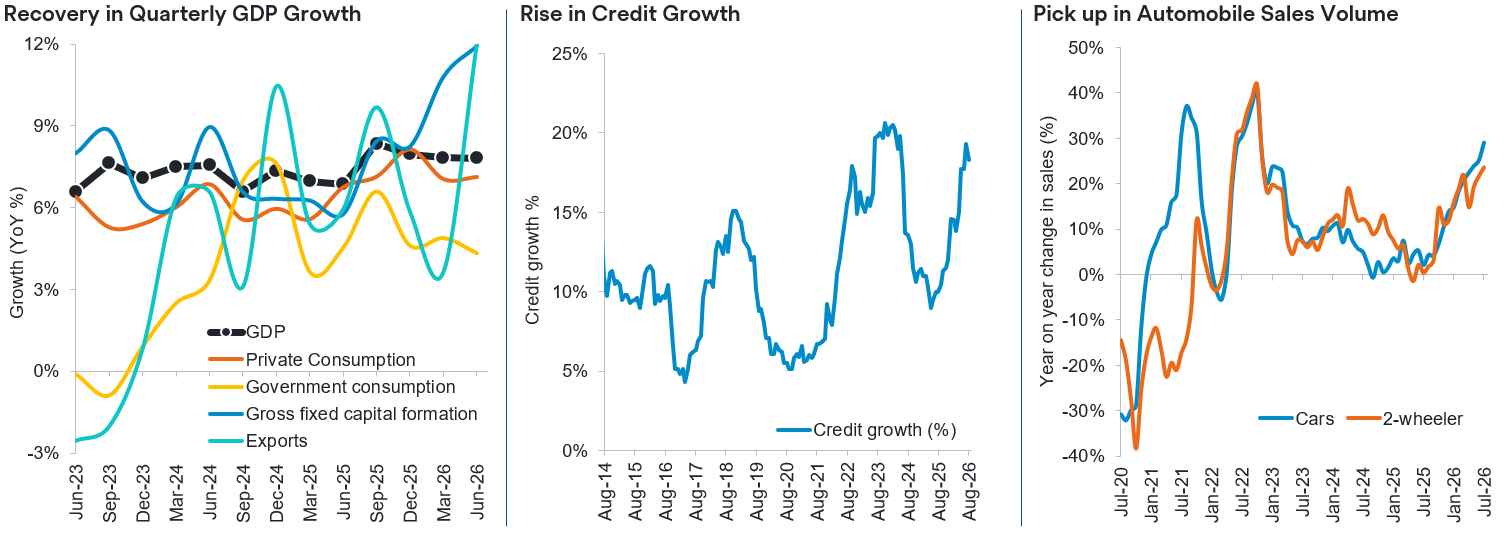
Supportive fiscal and monetary policy has allowed real and nominal GDP growth to strengthen over recent quarters. Income tax cuts have increased disposable incomes, indirect tax reforms have reduced prices of a range of mass-market products, lower inflation has allowed interest rates to fall, and government capital expenditure has picked up.
Chart 2: Most indicators point towards a recovery in economic activity
Source: Fidelity International, LSEG Datastream, 20 September 2026
Importantly, high frequency data such as car sales, two-wheeler sales, air traffic, FMCG volumes have strengthened, while credit growth accelerated from around 10-12% last year to approximately 18-19% by August – September 2026. Government and private-sector capital expenditure including infrastructure spending has also seen an improvement. The earnings backdrop is consequently more supportive making us more constructive on Indian equities.
Important to be conscious of the risks
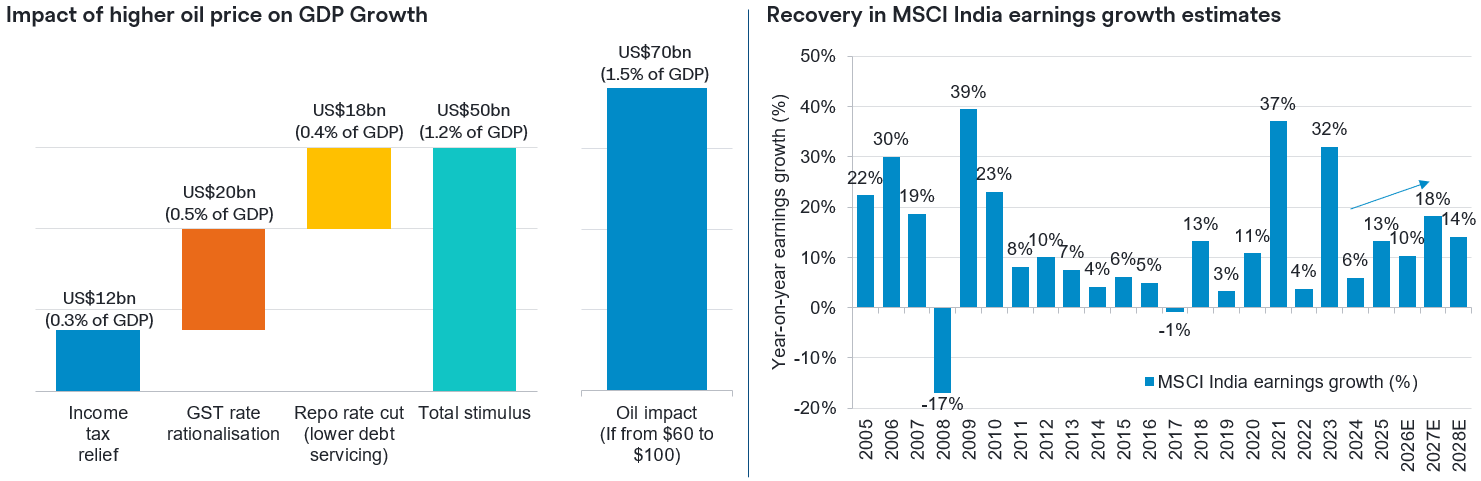
India is a large oil importer. A sustained high crude price therefore has implications for the trade balance, inflation, household consumption and the currency. If crude prices stay around US$100 per barrel as against US $60 per barrel before the Middle East conflict, GDP growth will likely be lower by 1.5%, which will potentially offset the fiscal and monetary stimulus support provided last year in the form of income tax cuts, goods and services tax rationalisation as well as a significant 125-basis point reduction in policy interest rates.
A second, medium term risk is the impact of AI on India's services-led growth model. Services exports have become an increasingly important counterweight to India's merchandise trade deficit. Accelerated automation of some white-collar jobs could therefore affect employment, consumption and export growth.
Chart 3: Earnings recovery but crucial to keep an eye on global oil prices
Source: Fidelity International, Morgan Stanley Research, 20 September 2026
We see oil primarily as a near-term cyclical risk, while AI represents a more complex transition. AI is likely to create deflation in parts of traditional outsourced IT services and automate some existing roles. At the same time, increasing adoption should create new demand for AI implementation, process automation, data modernisation, cloud migration and other higher-value services.
We therefore see AI both as a challenge to India's existing services model and as a potential source of new opportunities. At the same time, the government is implementing supportive policies to promote manufacturing which has so far been a stagnant part of India’s GDP.
The long-term investment case remains compelling
Despite these challenges, we believe India's long-term growth drivers remain compelling. India remains a large and predominantly domestically driven economy where private consumption represents around 60% of GDP, while significant infrastructure needs provide a long runway for investment and capital expenditure.
Penetration of many goods and services remains low compared with other emerging economies. As incomes rise, this creates structural opportunities across financial services, automobiles, healthcare, retail, e-commerce and other consumer categories. These characteristics should allow India to sustain relatively high economic and corporate earnings growth over the medium to long term.
This combination of structural economic growth and corporate earnings compounding has also translated into attractive long-term equity-market returns. Indian equities have generated around 6–8% annualised returns in US dollar terms over the long term to the end of August 2026.
With valuations now more reasonable and investor positioning significantly less stretched, we believe the starting point for investors has become more balanced.
Small-cap exposure
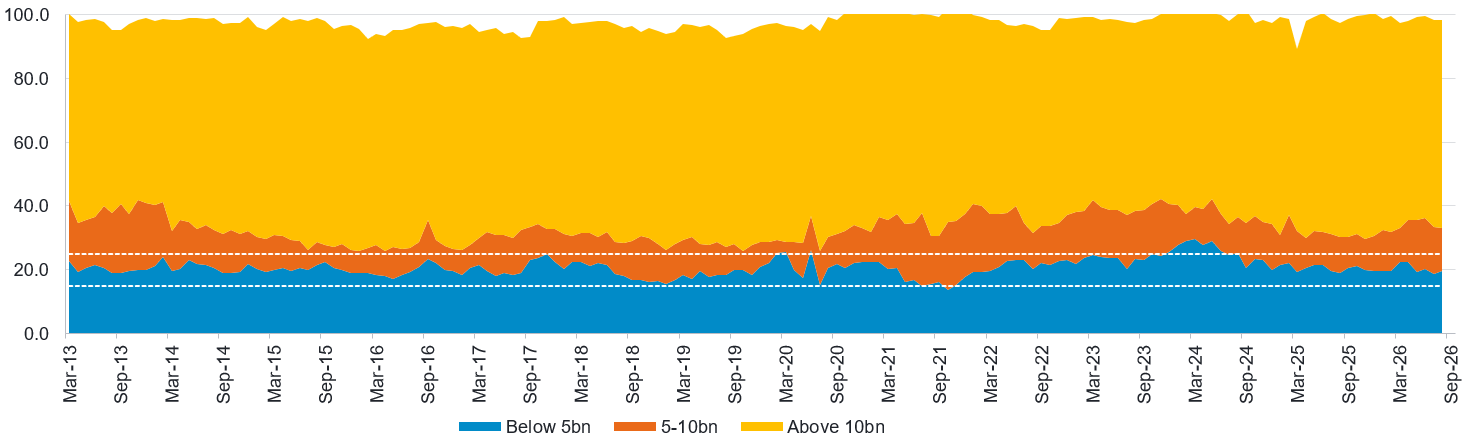
The Fidelity India Fund maintains a relatively consistent allocation of around 20%-25% to smaller companies rather than increasing this exposure to chase market momentum. While small caps can offer attractive growth opportunities, they can also have lower returns on equity, more volatile earnings and greater liquidity risk, which can become particularly critical when the cycle turns.
We therefore invest selectively, focusing on smaller companies that we believe can deliver sustainably higher long-term returns than larger companies to compensate for these additional risks, backed by strong and trustworthy management teams with the ability to navigate different market cycles.
Chart 4: Consistency in small-cap exposure
Source: Fidelity International, Data as at 31 August 2026. Comparative Index: MSCI India Capped 8% Index (Net).
Our investment strategy in the current environment
We continue to build the Fidelity India Fund from the bottom up, looking for high-quality businesses with sustainable growth, strong management teams and balance sheets, and reasonable valuations.
This investment philosophy has not changed, but more recently, the combination of improving domestic fundamentals, stabilising earnings expectations and more reasonable valuations has allowed us to become more constructive in our positioning.
Below are some of the areas where we are increasingly finding investment opportunities.
Healthcare: taking profits after strong performance
Healthcare has been one of the strongest areas of stock selection for the Fund. The sector remains a structural overweight, particularly through high-quality private hospital chains benefiting from rising healthcare penetration and the shift away from sparsely available, often lower-quality government care and a highly fragmented private sector.
Our holdings in two of the country's leading hospital companies, Apollo Hospitals and Fortis Healthcare, continue to deliver profit growth of 15–20% CAGR. However, their share prices have performed strongly and valuations have risen. We have therefore taken some profits and scaled back our exposure to these businesses.
At the same time, we are adding to businesses in the healthcare sector where we continue to see attractive long-term compounding potential.
Consumer discretionary: increasing exposure as consumption recovers
Consumption has improved over the past two to three quarters, with particularly encouraging trends in automobiles and specialty retail. We continue to prefer businesses offering stronger structural growth through increasing penetration, market-share gains, formalisation and changing consumer behaviour.
We also favour emerging business models that combine value, quality and convenience and have significant scope to gain share as Indian consumption grows and formalises.
For instance, we have increased exposure to Lenskart Solutions. It is India's leading eyewear brand, combining online and physical retail with technology such as 3D facial mapping for virtual try-ons, manufacturing automation and vertical integration.
We believe it can deliver very strong earnings over the next three to four years through market-share gains, revenue growth and margin expansion as India's approximately US$9 billion but highly fragmented and informal eyewear market formalises and continues to grow at a low-teens rate.
Chart 5: Sector allocation is an outcome of stock selection but reflects our overweights in areas offering long-term structural growth opportunities
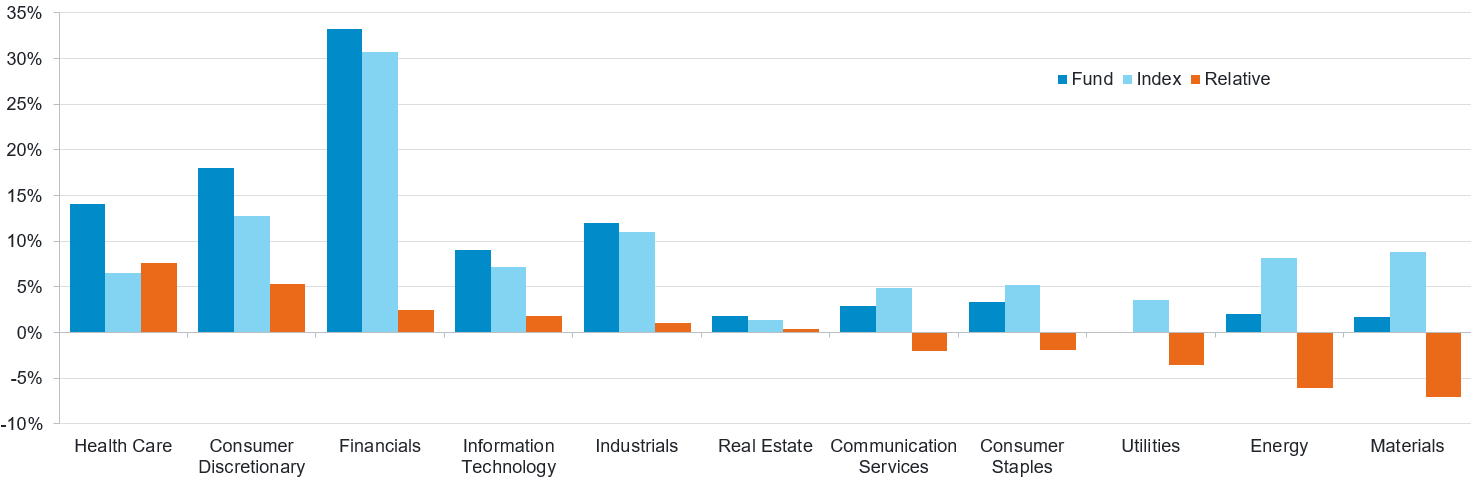
Source: Fidelity International, Data as at 31 August 2026. Comparative Index: MSCI India Capped 8% Index (Net).
Financials: still attractive, but increasingly selective
Financials remain an attractive way to participate in India's domestic recovery. Credit growth has accelerated and net interest margin pressures are stabilising as the interest-rate cycle bottoms, putting selected financial companies close to an earnings inflection point.
During the second quarter of 2026, we increased the Fund's overweight in financials while shifting towards businesses offering stronger returns on equity and higher growth. We find non-bank financial companies particularly attractive as the credit and asset-quality cycles improve.
We added exposure to Cholamandalam Investment & Finance and Bajaj Finance, which are growing revenues and profits at a robust 20-25% pace.
IT: opportunity emerging from the AI disruption
IT services are particularly interesting because the same AI concerns weighing on India's macro-outlook have created bottom-up investment opportunities. The sector has derated significantly even though near-term revenue growth and margins have remained relatively stable, leaving valuations and investor expectations at much lower levels.
AI will create deflation in traditional application development and other legacy services. However, we expect this to be increasingly offset by new demand for AI implementation, agentification and process automation, data modernisation, cloud and security. India's IT-services companies have deep enterprise relationships and expertise that should allow selected businesses to participate in this transition.
We therefore distinguish between the near-term disruption AI may create for India's services-led economy and the medium-term investment opportunities it is creating in selected IT-services companies.
We added back to our IT services exposure in July as the risk-reward became more attractive. Cognizant is now the Fund's largest single-stock overweight. Even after rebounding roughly 50% from its lows, the stock trades at around 10x its 2026 earnings versus approximately 15x for Indian peers.
Industrials: selective ideas as India broaden its growth model
India's growth has increasingly been driven by services, while manufacturing's share of GDP has stagnated. Government policy is therefore increasingly focused on strengthening manufacturing to broaden the country's growth drivers, create jobs and capitalise on India's demographic dividend. At the same time, enthusiasm around AI infrastructure spending and improving government and private-sector capex led us to add select holdings to the sector.
Looking ahead, we believe India's structural growth potential and increasingly broad investment universe continue to offer attractive long-term opportunities. More reasonable valuations and improving fundamentals are creating opportunities across financials, consumer discretionary and IT services, while we remain selective where valuations have risen.
Against this backdrop, we remain focused on disciplined, bottom-up stock selection and investing in high-quality growth businesses at reasonable valuations. We believe this approach is well suited to capturing India's long-term growth through different market cycles.