Top multi asset convictions:
-
For total return investors: AI and grid infrastructure, Japanese banks and mid-caps, and high yield bonds given attractive all-in yields.
-
For income investors: high yield, emerging market hard currency debt, and selective EM local debt. High dividend stocks are expected to provide both income and diversification, held alongside the key total return themes.
-
For defensive investors: contractual hedges like put options and credit derivatives may prove important for downside protection; statistical hedges like bonds, gold, and defensive FX (such as the Swiss Franc) may mitigate other risk factors.
Markets and economies find themselves more and more entwined: technology giants have deployed capex across an expanding AI value chain, and strong corporate earnings have supported markets everywhere from the Nasdaq to the Nikkei.
Where investors once were happy to reward companies that overshot market expectations for AI-related capex, any unproductive spend is likely to be punished in 2027. Rising interest rates and wider credit spreads are pushing up the cost of funding such investments, and a fragmenting global economy adds volatility to a complex macroeconomy. We enter a world of still-resilient growth, built on increasingly shaky foundations.
At trend growth, risks mounting
AI investment continues to be the primary positive driver for economies, especially in the US, where growth levels are likely to moderate but remain solid at around 2 per cent. Corporate spending is fuelling private investment in infrastructure and supporting higher AI earnings growth, and equity market gains are spurring consumption levels.
The US in 2027: Growth likely to move towards trend pace (2%) as the effect of Fed hikes filters into the macro environment
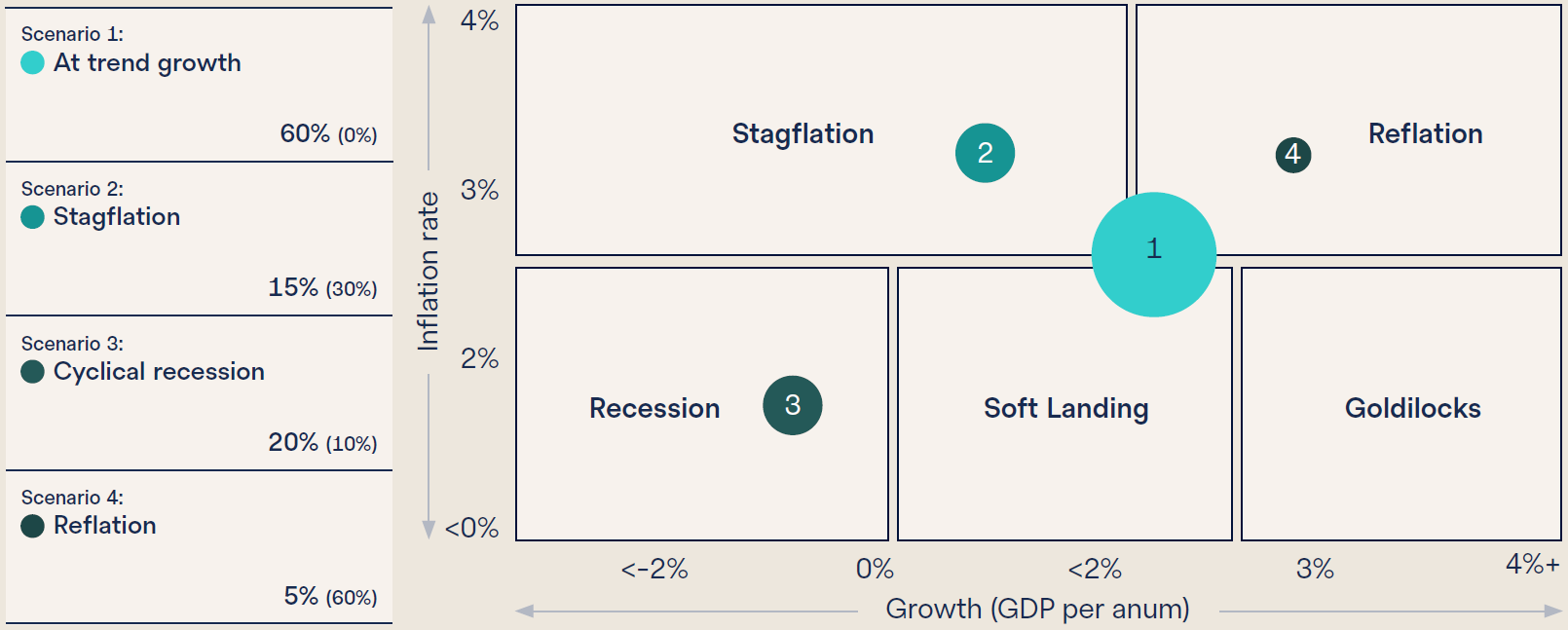
Source: Fidelity International, November 2026
Growth in Europe meanwhile has proven surprisingly resilient. German fiscal expansion has boosted manufacturing and this is likely to persist in 2027. But French political uncertainty and higher energy prices may challenge this outlook. The European Central Bank has already raised rates twice and is likely to do so twice more to stay ahead of inflationary pressures.
In Asia, the Japanese government is hoping to encourage investment into rebuilding manufacturing capacity. For the year ahead, we anticipate continued wage-led and investment-driven reflation in the country.
The latest Chinese five-year plan likewise emphasised investment in manufacturing, with a move away from property as a growth-driver. We anticipate the People’s Bank of China will still focus on easing conditions, targeting stimulus at priority sectors. (You can read more on the investment implications for these countries in our Asia outlook.)
Strategic fragmentation, inflation, and active allocation
Our outlook for 2027 sits in a wider context of ‘strategic fragmentation’ - the retreat from globalisation towards the formation of regional blocs.
In this splintering world order, ports, pipelines, straits and payment rails turn into economic leverage. Increasingly, hard power is used to draw newly calculated lines and borders, which will sit at odds with commercial priorities.
This makes fragmentation structurally inflationary. A world split into regional blocs compels each to invest in its own resilience. This is especially true as AI brings with it national security considerations, encouraging countries to shift from the US as a single point of AI risk.
AI capex likely to top $4.5tn in race for self-sufficiency
Projected AI capex spend by country/bloc
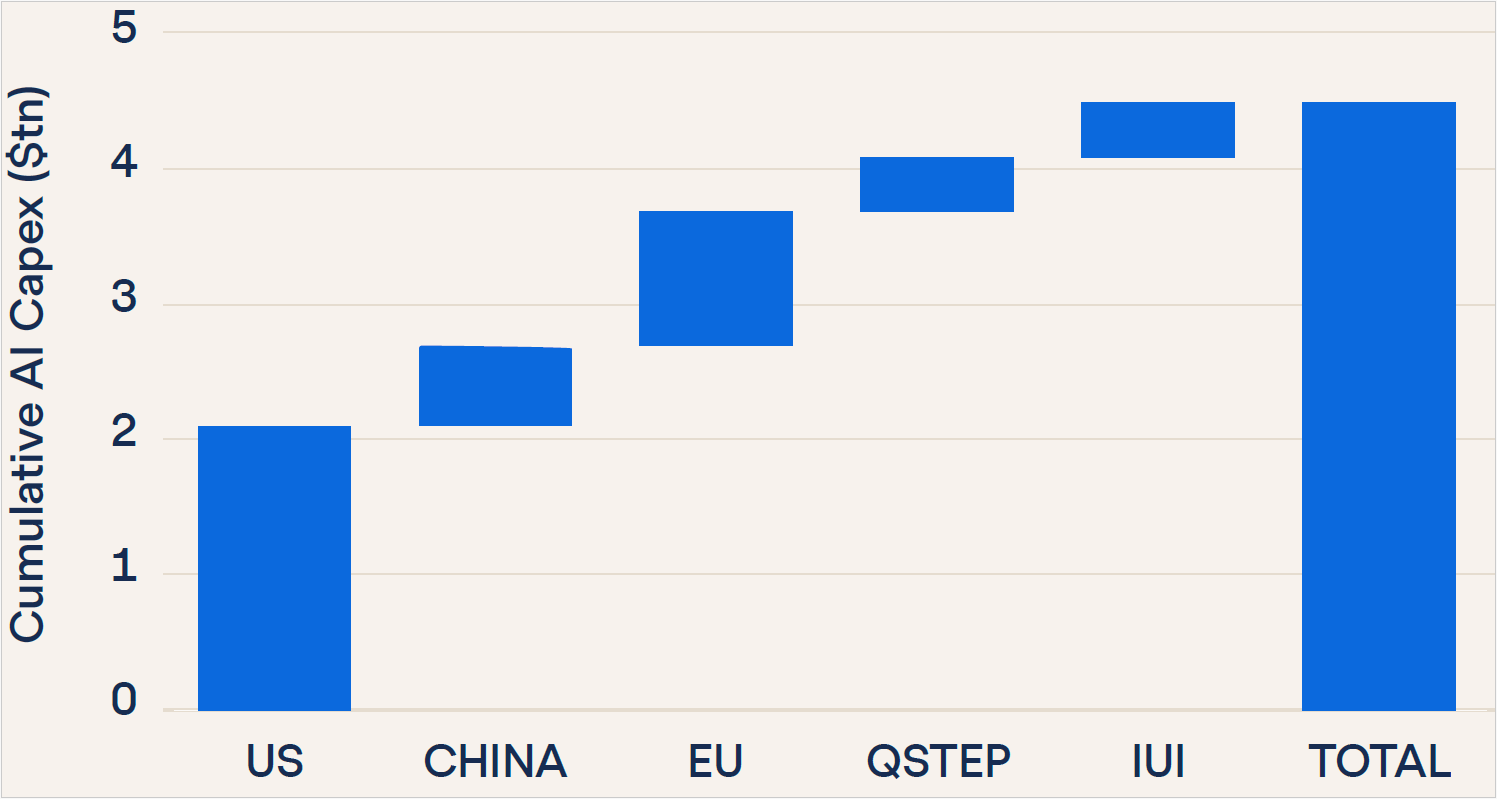
Note: US AI Capex calculated as total realised US hyperscaler capex since Q1 2023 ($1.2tn) + analyst forecasted capex over the next 2yrs ($900bn). Other blocs/countries calculated at a discounted ratio of bloc per capita GDP over US per capita GDP, with a minimum assumed spend of $400bn. Given direct competition, China is assumed to need to spend more than this calculation. QSTEP: Qatar, Saudi Arabia, Turkey, Egypt, Pakistan. IUI: India, UAE, Israel.
Source: Fidelity International, FIL Global Macro & SAA Team calculations, Bloomberg, World Bank WDI, July 2026.
While the macro backdrop is complex, we are cautiously optimistic about markets through 2027, while recognising that late cycle risks abound, exaggerated by an increasing interdependence across regions and sectors because of the AI build-out.
Through 2027 we will be looking for risk opportunities but via routes with a comfortable margin of safety. Five themes stand out:
1. AI rewards and risks
AI capex is likely to remain a dominant driver of markets in the year ahead, and we want to ensure we maintain exposure to the structural theme. Tech and tech-adjacent sectors now contribute around half of the total earnings growth for the S&P. But as risks mount, we are becoming increasingly selective in our allocations.
The US build-out in particular faces challenges stemming from data centre delays, as signalled by November’s sell-off following the Democrat mid-term sweep. “Texas is expected to account for roughly 25-30 per cent of the data centre capacity coming online over the next few years,” says technology analyst Austin Kelly.
“The shift in power in Texas has created uncertainty over how much of that capacity will come online. The market hates uncertainty and downside to fundamentals that it struggles to quantify.”
Rising borrowing costs add another source of pressure, raising the returns required to justify AI capex. Investors are likely to start discriminating between the companies that can fund and realise returns from their AI spend, and those that can’t.
Tech capex is pulling ahead of free cash flow
Quarterly totals for Meta, Alphabet, Microsoft and Amazon
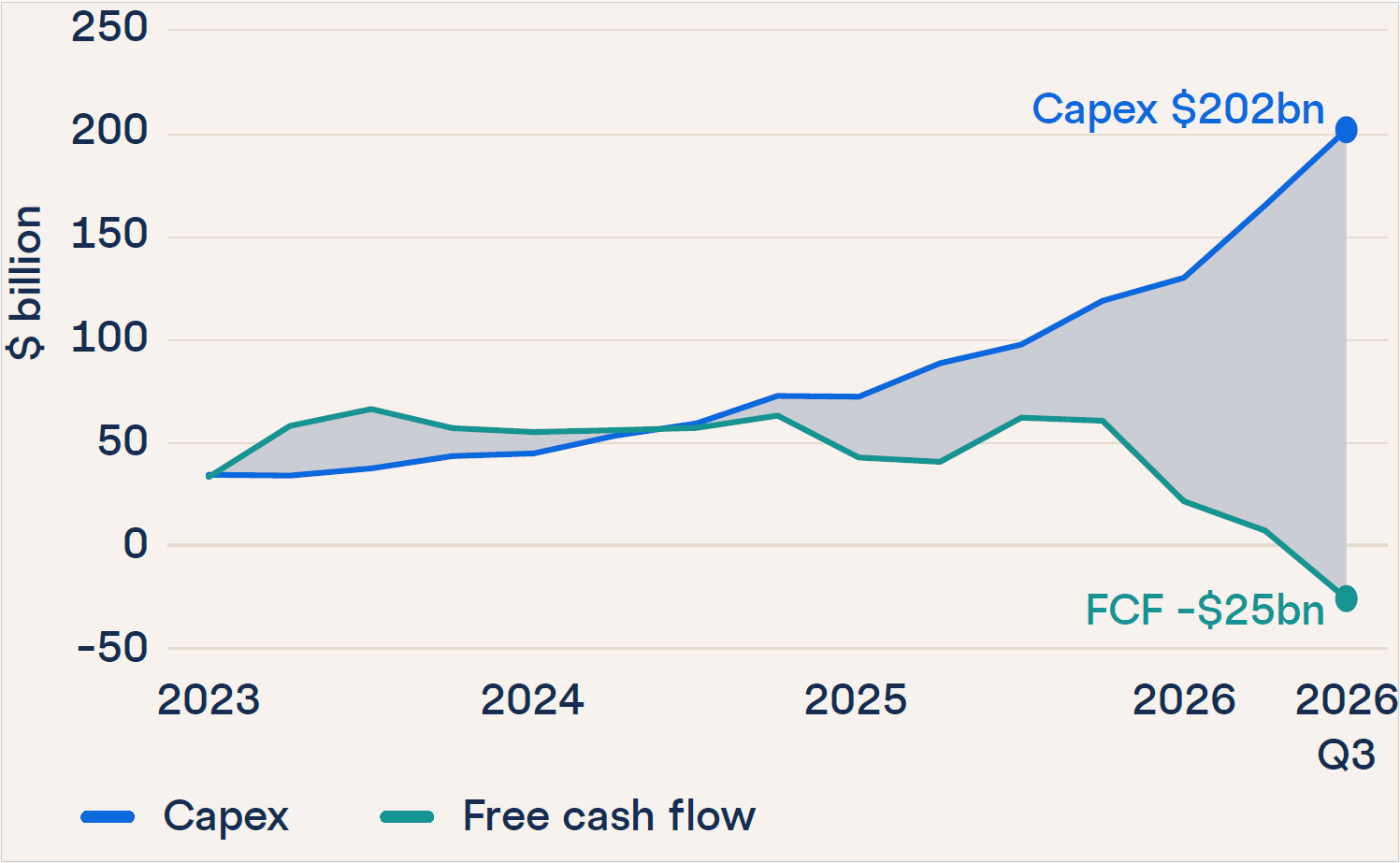
Tickers: META US Equity, GOOGL US Equity, MSFT US Equity, AMZN US Equity. Fields: CAPITAL_EXPEND and CF_FREE_CASH_FLOW; quarterly USD millions summed across firms, converted to USD billions. No rolling sum. CAPITAL_EXPEND is a negative cash outflow; sign reversed for positive capex. Gap is an arithmetic difference, not external financing need.
Source: Fidelity International, Bloomberg, 02 November 2026. Latest financial quarter 30 September 2026.
Well-capitalised hyperscalers look best placed to absorb delays to data centre construction. We are still positive on compute and memory over the long term as valuations have dropped, but wary of building too much exposure here while AI financing conditions look volatile. (Read more on the earnings test for AI in our equities outlook.)
2. Non-AI alpha
Given these risks, we will also look to alternative sources of alpha where earnings are not correlated with AI performance.
These include German infrastructure - a sector supported by the country’s fiscal policies; and Japanese mid-caps and financials, which gain from fiscal spending, strong domestic demand, and corporate reforms.
3. The bond balance for multi asset investors
Bond yields are likely to remain elevated throughout 2027, offering meaningful income opportunities even after adjusting for inflation.
We favour high yield bonds for their attractive all-in yields, supported by strong fundamentals and low default expectations. We believe investment grade spreads have been too tight to warrant taking the additional risk and hence push us towards allocating to shorter-dated credit strategies. Hawkish central banks and the risk of oil price spikes keep us from moving into longer-dated bonds.
While bonds are unlikely to protect portfolios against inflationary shocks, their diversification benefits may re-emerge when markets become concerned about growth. Recent AI-related wobbles are a case in point, as broader economic worries prompted investors to seek protection in fixed income.
4. Diversifying for the moment
The diminishing role of bonds as diversifiers poses a challenge to multi-asset investors. Instead of splitting allocations simply between equities and bonds, we take two broad approaches to hedging to help manage portfolios through this late cycle: statistical and contractual.
‘Statistical’ hedges like gold, inflation-linked bonds, and crude oil each hedge specific risks in portfolios. Maintaining a relatively consistent basket of these assets can help create a more resilient ‘all-weather’ portfolio.
A basket of statistical hedges
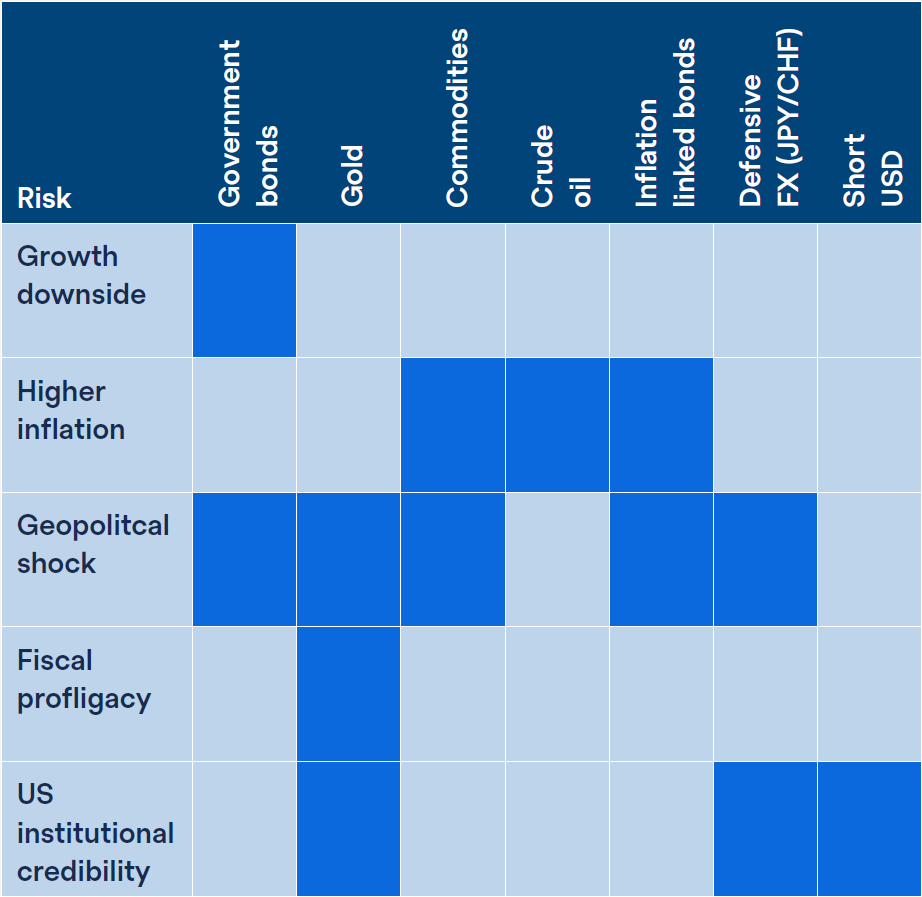
Source: Fidelity International, November 2026
‘Contractual’ hedges are those where the pay-off is explicitly linked to the risk being covered. Equity put options are the clearest example: if equity markets fall sufficiently, the option contractually increases in value, helping to limit drawdowns and reduce volatility.
The advantage of this contractual protection is certainty - investors know which risk they are targeting and can reduce its impact on portfolios. The disadvantage is cost. If the risk does not materialise, the premium becomes a drag on returns.
Investors can also mitigate concentration risk through regional breadth, adding factor exposures that tilt away from market-cap weights, and diversifying more broadly across factors and styles.
Private assets offer another source of diversification. It is important to draw on relationships with general partners to understand what they are seeing in their portfolio companies, how financing and exit conditions are changing, and where market volatility is creating opportunities. Investors can then test their perspectives through their own underwriting to decide where to commit capital in 2027.
In private equity, managers in the mid market look preferable for the long term through earnings growth and stronger cash conversion. We look for businesses that can attract both strategic buyers and larger sponsors, giving managers more flexibility on exit. For private credit, senior direct lending provides a base of contractual income. Where credit market weakness creates attractive entry points, we would back managers specialising in special situations to add a source of return from restructurings and recoveries.
A way through
We live in a world in which much can change in a short time. The above outlines what we expect to happen, but we will be watching certain areas keenly and pivot our views if necessary. These include any developments in the ongoing conflicts in Iran and Ukraine, plus the rising threats posed to countries’ cybersecurity; the Fed’s response to incoming inflation data; further US trade tensions and how these impact Asia Pacific nations in particular; how a Democratic Congress affects the AI build-out; and whether AI adoption or monetisation disappoints. Flexibility will be critical in the year ahead.
Outlook 2027
Access the full report for our in-depth macro and investment views all in one place.