Top equity convictions:
- The AI story: focus will intensify on where capital is being used effectively. We opt for hyperscalers, and semiconductor suppliers with clear competitive advantages and pricing power.
- US and European banks are benefitting from resilient lending, higher yields, and the efficiencies AI has brought to operations.
- Industrials are positioned for a broadening cyclical recovery. Defence, infrastructure, and aerospace investment are driving demand, but opportunities are emerging in high-quality, rate-sensitive businesses that have yet to participate fully in the recovery. Favour companies with pricing power and the ability to protect margins against cost inflation.
I am positive on stocks for 2027. Fidelity’s analysts estimate global earnings will have risen 33 per cent by the end of 2026, and they expect an increase in the high teens in 2027. That is a slower pace, but still strong growth from a much higher base.
Valuations also offer a better starting point. The MSCI World index is trading at around 17 times forward earnings, compared with roughly 20 times heading into 2026. If companies deliver the expected profits, and multiples broadly hold, earnings growth should support further returns.
The source of returns
Cumulative weekly change (MSCI AC World)
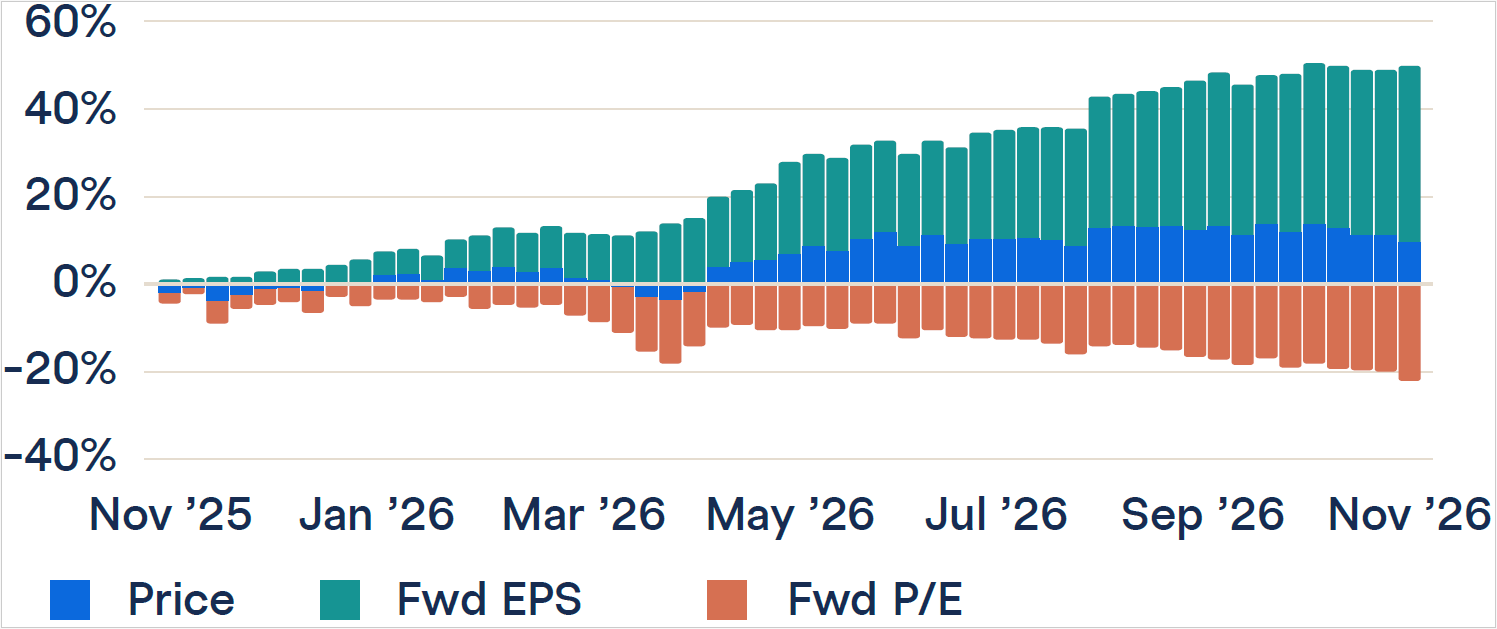
Source: Fidelity International, LSEG, November 2026.
Despite the volatility, the strongest forecasts remain in technology. Banks also look attractive, while parts of the industrials sector have scope for recovery. For tech this is a ‘show me’ year: companies will need to demonstrate that their heavy investment can deliver. The main risk is that disappointing returns on AI investment, or tighter financing conditions, undermine both earnings and valuations.
AI demand and the returns behind it
Individuals and businesses are still a long way from making full use of what AI can do. That is an important underpinning for the continued growth in demand for AI as a product. Companies have considerable scope to become more efficient by moving applications from trials into everyday operations. But for investors, the upside is less about faster adoption than it is about greater confidence in the durability of that demand. Evidence that customers can earn attractive returns across a wider range of applications would support continued spending.
Those customer benefits do not guarantee attractive returns for every supplier or its shareholders. Some high margins reflect scarcity pricing, so we need to assess what businesses can earn once capacity expands.
Tech earnings growth still surging
Fidelity analyst forecasts ($)
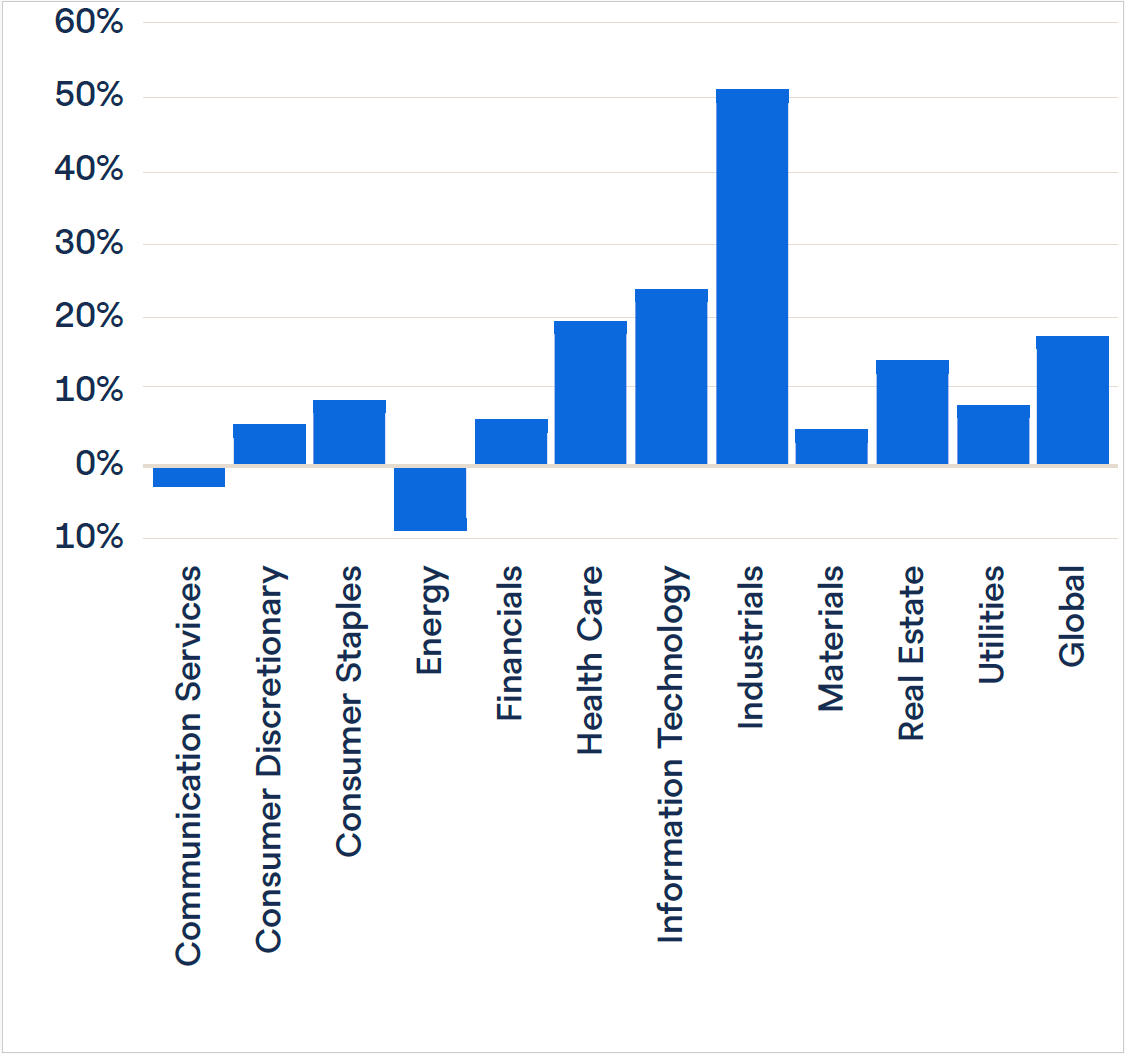
Source: Fidelity International, November 2026.
The technology should keep improving. Its ability to interact reliably with the physical world is at an early stage, with substantial potential in robotics and industrial processes. We see these capabilities primarily as a longer-term driver of revenue growth and do not need those gains to arrive in 2027 to support the near-term case.
Despite local opposition to data centre development in some markets, our technology analysts expect AI infrastructure capital expenditure to increase in 2027. Memory and select hardware shortages will persist, with meaningful additional capacity before 2028 unlikely in some markets. Those shortages should support suppliers’ pricing and earnings through 2027.
Power and grid constraints have different effects and the particular situations and profiles of projects and companies here will be vital. Those that have secured permits and power supplies can bring capacity into use while others wait. Delayed connections may strengthen existing operators’ positions but push back equipment orders for new projects. Additional construction and financing costs can also reduce project returns. I would expect investment to favour regions that are able to provide power, timely approvals, and reliable grid access.
As to what actually looks attractive for investors, our analysts favour established cloud platforms with diversified revenues, strong cash generation and installed capacity, alongside selected semiconductor suppliers with competitive advantages and well-funded customers.
For companies relying on external capital, we also need to ask what funding will cost in 2027 and what that leaves for shareholders.
“Cash flow discipline does not require every new project to pay back in 2027,” says technology analyst Jonathan Tseng. “An innovation-led business may justify substantial investment before generating free cash flow. We need evidence that returns can exceed the cost of capital, and that funding can last if commercial progress takes longer than planned.”
For established businesses, it is however important that new spending is assessed separately from existing profitability: a strong core can fund poor expansion decisions for some time.
Opportunities beyond technology
With the macro environment still broadly supportive, our view on US banks is constructive but it is also highly selective. Earnings growth is likely to moderate but should remain healthy and our analysts expect loans to grow in the mid-single digits without a significant deterioration in credit quality. Some easing of regulation could free up capital for lending, dividends and share buybacks, while AI-driven efficiency gains make a more meaningful contribution to profitability. Implementation costs and savings passed to customers will determine how much shareholders retain.
In Europe, valuations still appear to understate the improvement in the underlying franchises. Deposit competition and the risks from credit losses both bear watching, but lending is recovering.
"Banks now combine strong capital and liquidity positions with improved efficiency and profitability," says Fidelity sector analyst Omar Fall. "We see a compounding story in the sector, not just a rates trade."
The opportunity in parts of the industrials sector is different. AI-related investment and commercial aerospace have been strong, but many interest-rate-sensitive businesses are still struggling to recover from the 2023–2025 downturn. Cost inflation continues to put pressure on margins. We want to be paid for the risk of waiting, rather than buying on the assumption of a rapid recovery.
“We are finding established companies at valuations that look attractive against their earnings potential through the cycle,” says portfolio manager Ashish Bhardwaj. “They do not need another investment boom. Returning customer demand would help them use existing capacity more fully and improve profitability.”
In other areas, lower energy costs from improved supply could ease pressure on household budgets and help consumer spending recover. But housing and larger purchases remain sensitive to borrowing costs, and we would not assume a synchronised recovery.
The risks from bond and credit markets
Bond yields have already risen, and equity multiples have fallen, but we cannot be certain the adjustment is complete. Persistent fiscal deficits could yet provoke a loss of confidence in government finances and another abrupt rise in yields. Higher yields reflecting stronger growth can be accompanied by better earnings; a fiscal shock offers no such reassurance. Equity valuations can come under pressure even if profits hold up.
Where yields start to hurt
US 10-year yield vs change in S&P 500 PE multiple (YTD)
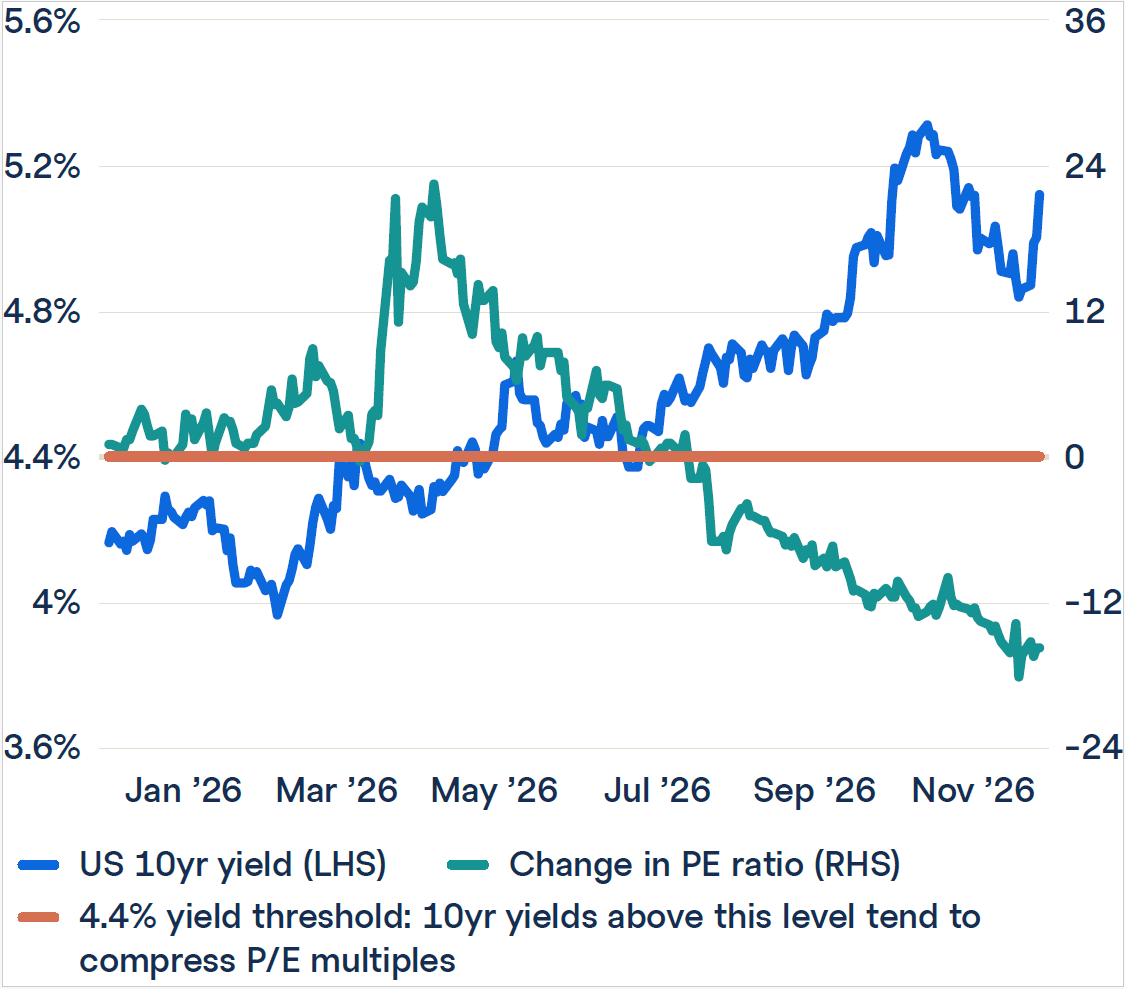
Source: Fidelity International, LSEG, November 2026.
A separate risk is that isolated credit losses lead to a broader reassessment of credit risk. Investors could demand higher spreads and lenders become less willing to extend credit, affecting refinancing and investment across the economy as well as banks’ own earnings. Government bond yields need not rise for corporate financing conditions to tighten. I will be watching for evidence that credit losses are becoming more widespread and lenders are curtailing credit, rather than treating every isolated loss as a sign of wider trouble.
Neither shock is my central expectation for 2027, but both could materially weaken the equity case. Tighter credit combined with disappointing AI investment returns would be particularly damaging. Other sectors may not be able to offset a slowdown in technology if they, too, face more expensive or less available finance.
Strong cash generation and manageable refinancing needs matter in that context. They will not protect share prices from a market-wide repricing, but they reduce the risk that a financing problem causes lasting damage to a business or to its value to shareholders.
The test for 2027
We do not need a repeat of 2026’s earnings growth, or a return to 20 times forward earnings, to find attractive opportunities in the year ahead. We do, however, need confidence that companies can deliver the profits expected, convert them into cash, earn returns above the cost of capital, and fund their plans through less favourable conditions. That is the earnings test for 2027.
Outlook 2027
Access the full report for our in-depth macro and investment views all in one place.