Top fixed income convictions:
-
Short-dated credit: less sensitive to further increases in yields, and less exposed to the AI theme.
-
Select emerging markets: can offer attractive carry with better fiscal dynamics than some developed market peers.
-
Cross-market opportunities: favouring traditional infrastructure assets versus data centres, for example, or selected euro investment-grade names versus US peers.
If you take one message away from this fixed income outlook, it should be: don’t try to time the turning point for duration.
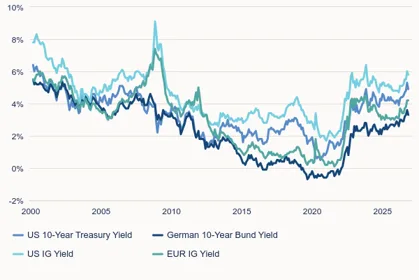
Duration’s time will come. But not only is market timing a notoriously unreliable endeavour, there’s also little incentive to take such a risk. Yields today are a lot higher than they have been over most of the last two decades.
As we head into 2027, therefore, investors should focus on generating high-quality carry while keeping a watchful eye for opportunities to extend duration. The extra carry-on offer compared to recent years gives investors a cushion to absorb further volatility, which we certainly anticipate. Indeed, recent stock market action is a reminder that market conditions can and do change quickly, and that it pays to stay prepared.
More yield, less hunting
Source: Fidelity International, Bloomberg, November 2026.
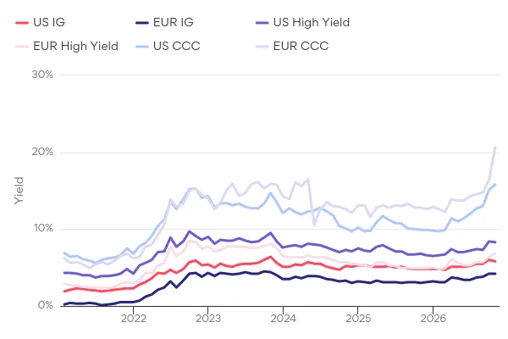
We are also starting to see more dispersion in credit markets.
“Growing dispersion gives us greater scope for active management, including ways to hedge against the AI trade that has become the dominant driver of many investors’ portfolios,” says portfolio manager James Durance. “It also highlights the importance of avoiding weaker issuers.”
Credit dispersion has become more pronounced
Source: Fidelity International, Bloomberg, November 2026.
Higher for longer, but not necessarily forever
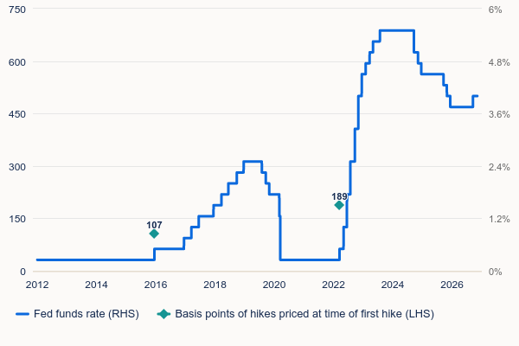
A big reason we advocate patience is that yields could still move higher from here. In the US, inflation remains stubbornly above the Federal Reserve’s target. Economic growth has also shown resilience so far, suggesting further interest rate hikes may be needed to bring inflation down, while fiscal pressures and concerns about bond market supply could also keep yields elevated.
History also suggests that investors have a habit of underestimating the scale of a hiking cycle at its outset, adding a further note of caution.
Interest rates could go higher than you think
Source: Fidelity International, Deutsche Bank, Bloomberg, St Louis Fed, November 2026.
However, at some point in 2027, borrowing costs may start to weigh on economic activity. Keep in mind too that the composition of US growth has shifted markedly towards AI and data centre investment over the last few years. In other words, capex rather than consumption is centre stage, and capital spending is famously prone to sharp, procyclical reversals when animal spirits turn cautious.
This is why we want to look for opportunities to add duration selectively. In the meantime, exposure to high-quality short-dated credit, which is less sensitive to further increases in yields, offers a way to generate income for a portfolio.
“Persistent inflation pressures from higher commodity prices and geopolitics have created uncertainty around central bank policy,” says Durance, “reinforcing our conviction in the short-duration part of the curve, where investors can capture attractive income with less exposure to rising yields.”
Short-dated credit also tends to be less exposed to the AI theme, given that AI borrowing has been concentrated at the long end.
AI credit supply is raising eyebrows
One example of credit dispersion came from Meta’s bond offerings at the start of November 2026. The fundraising included the company’s first ever sale of euro-denominated bonds, issued during a period of heightened market volatility. Despite strong demand, Meta issued the new debt at a notable discount.
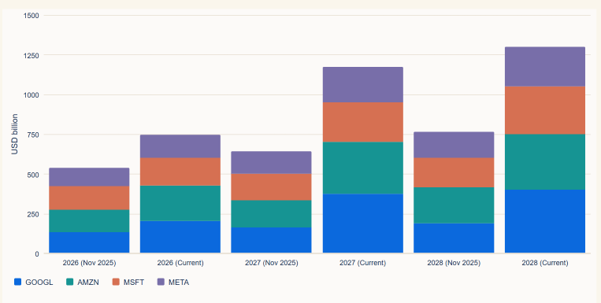
The episode illustrates both the ongoing enthusiasm for the AI trade and rising circumspection among investors. Market participants have noted the implications for future funding needs of AI infrastructure spending, and what that means for bond market supply now that hyperscalers have moved beyond financing their AI capex from free cash flow.
AI capex revisions point to sustained funding needs
Estimates from Nov 2025 vs current estimates
Source: Fidelity International, Morgan Stanley, 1 October 2026.
On the one hand, the Meta example shows there are opportunities in the current market to earn good yields from solid investment-grade credits. On the other, the potential scale of future AI-related issuance suggests it would also be prudent to look at how to hedge AI exposure by investing in other areas. Meta’s November issue notwithstanding, credit spreads remain historically tight, and investors should be sure they’re satisfied that the compensation on offer justifies the risk being taken.
Looking for ‘anti-AI’ fixed income investments
In the infrastructure space, assets like motorways and airports look more attractive right now than AI-related infrastructure. Leverage tends to be lower, track records are longer, and there is much less sensitivity to economic growth.
Regional dispersion meanwhile has created relative-value opportunities. French sovereign weakness has led to an unusual inversion. At one point in October, almost 40 per cent of French investment-grade corporate bonds traded at lower yields than comparable government debt.
The spillover from the volatility in French government bonds has weighed on European investment grade, creating selected opportunities in European banks, insurers, and corporate hybrids. And, of course, it has improved the relative value of French (as well as Italian) government bonds compared to high-grade corporate debt. Selective government-spread exposure appears more inviting than broad corporate credit risk. However, we still retain a cautious outlook on Europe for 2027, given ongoing political uncertainty and the likelihood of further rates volatility.
Emerging market debt meanwhile continues to offer attractive all-in yields relative to the underlying risks.
“Latin America benefits from high real yields and exposure to commodities, while in Europe and Africa several countries have made progress in reducing fiscal vulnerabilities through stronger revenue collection and greater expenditure discipline,” says portfolio manager Philip Fielding.
The Middle East has proved resilient in the face of the conflict in Iran, while initial concerns about supply disruptions in Asia, as oil shipments were unable to transit the Persian Gulf, have largely proved unfounded. Higher petrol, diesel, and jet fuel prices have generated some inflationary pressures, but central banks have generally reacted prudently, limiting the risk of inflation expectations becoming de-anchored.
In many cases, emerging market sovereign fundamentals compare favourably with those of developed market peers.
Is the script flipping for EMs vs DMs?
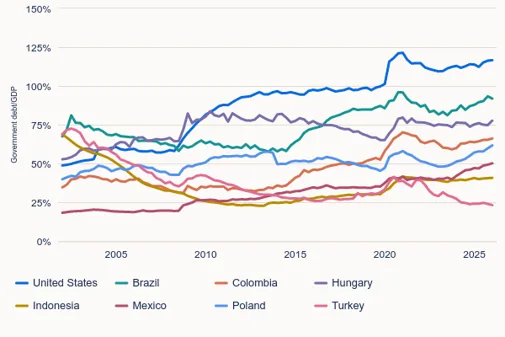
Source: Fidelity International, Macrobond, Federal Reserve, October 2026.
Economic growth is higher, public debt burdens are generally lower, populations are younger, and companies are more conservatively financed. This creates differentiated sources of return for investors that should be accessed via a strategic allocation rather than a tactical approach.
Finally, the technical backdrop remains supportive for the asset class with net bond supply relatively low, particularly when compared with substantial issuance volumes in the developed market technology sector.
Active investors can afford to wait
AI-related growth, persistent inflation stoked by the Iran conflict, and an oversupply of debt driven by AI capex and government borrowing have made 2026 a challenging year for fixed income, underlining the importance of being patient and selective. Those same challenges have also helped make fixed income a more attractive asset class than it has been for some time.
In the months ahead, credit dispersion allows for selective risk taking as investors wait for more clarity on inflation, the economy, monetary policy, and even geopolitics. Duration, as ever, remains valuable as a protection against a sharp slowdown, although yields can still go higher from here. In the new year, patience will be a virtue.